Why You Keep Fixing the Same Problems (and They Keep Coming Back)
You have fixed this before. You hired the person, tightened the process, chased the leads, and months later the same problem is back in the same spot. It is not that you are bad at fixing things. It is that your problems are not a list, they are a loop, each one quietly rebuilding the ones you just fixed. Here is how to spot the loop in your own business, and why breaking it takes more than one fix at a time.
You have solved this problem before. Maybe more than once. You hired someone to take it off your plate, or you sat down one weekend and built a proper process for it, or you finally pushed hard on sales and the numbers moved. It felt fixed.
And then, a few months later, there it is again. The same problem, in the same spot, as if you had never touched it.
If that feeling is familiar, you are not bad at running a business, and you are not imagining it. You are almost certainly dealing with something most owners never get a name for. Your problems are not a list. They are a loop.
A list versus a loop
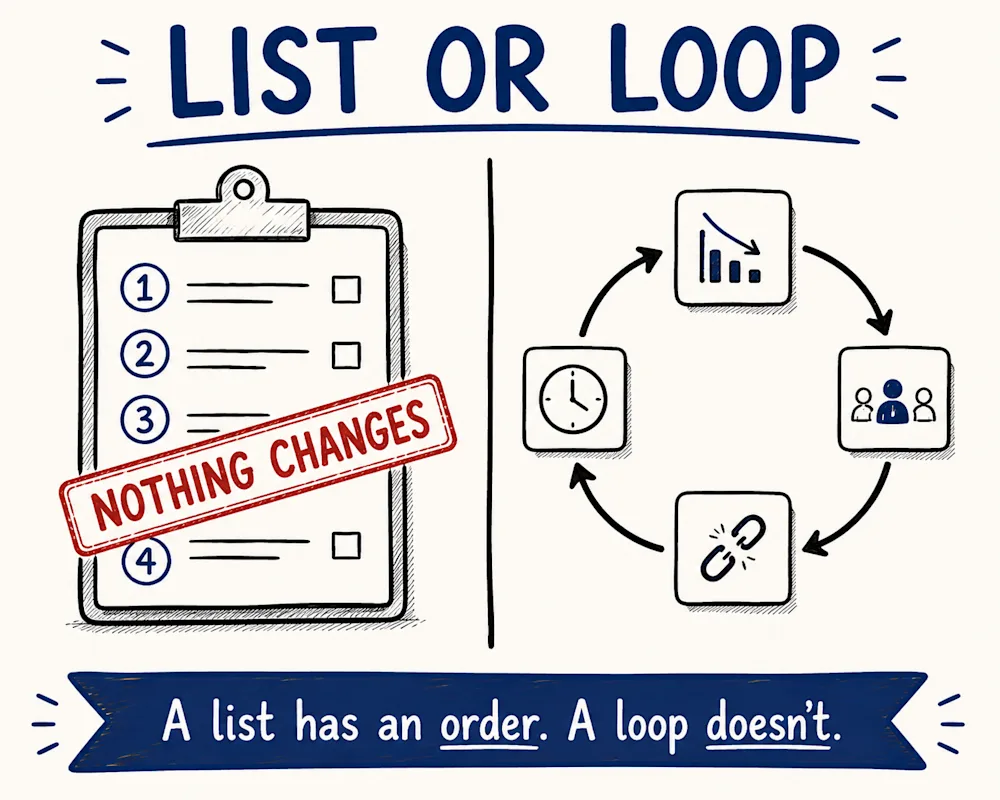
When we think about what is wrong with our business, we naturally make a list. Cash is tight. Good people keep leaving. The best clients are all mine personally. Marketing does not really work. Four problems, and the plan seems obvious: fix the most urgent one, then the next, then the next.
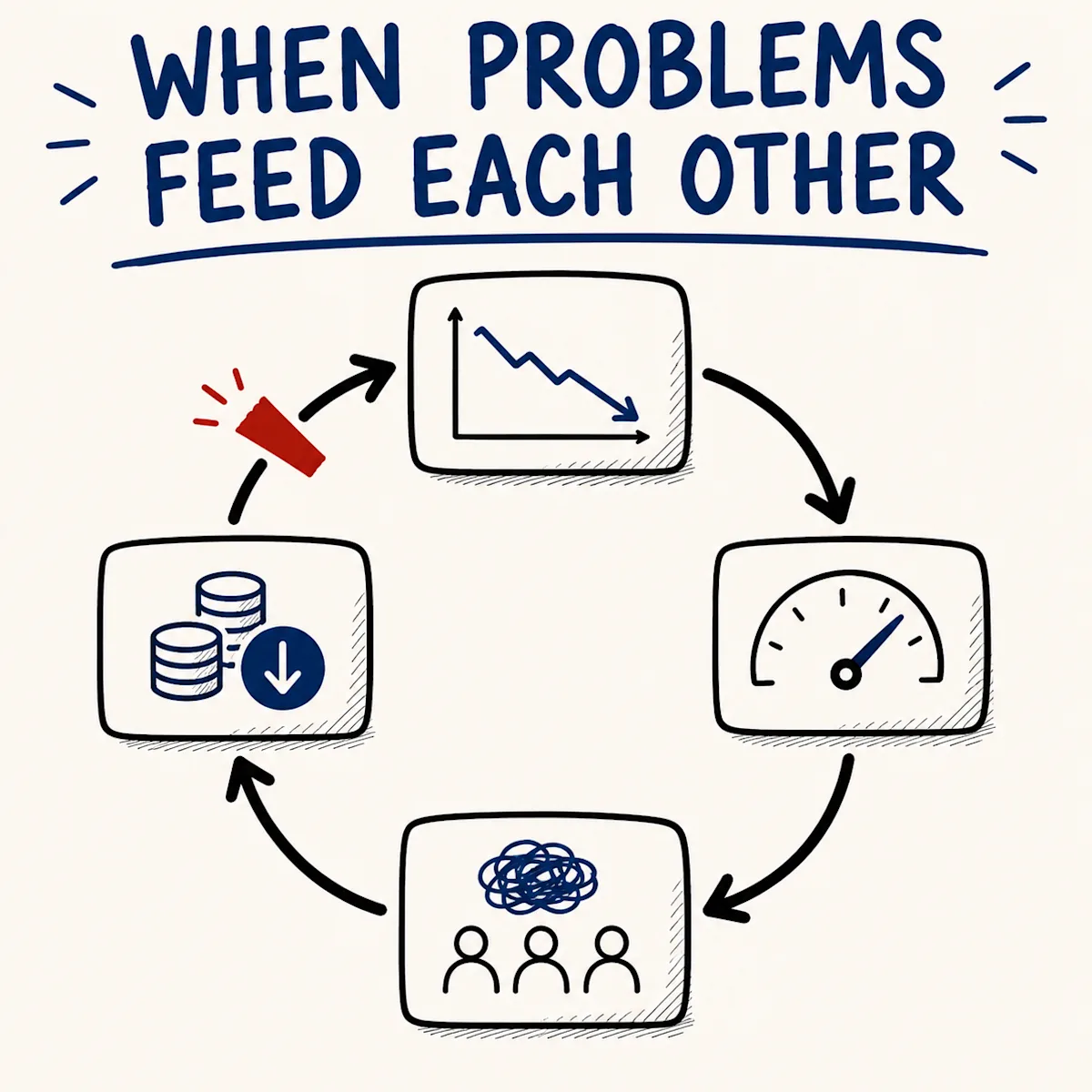
That plan works when the problems are strangers to each other, when fixing one has nothing to do with the others. But in most small businesses, the problems are not strangers. They are wired together. Each one causes the next, and the last one loops back and feeds the first.
Here is a shape you might recognise. You have no real sales system, so most of your revenue comes from a few clients you personally landed. Because so much rides on those few clients, you spend every week keeping them happy. Because you spend every week firefighting, you never have time to build a sales system. So most of your revenue still comes from a few clients you personally landed. Round and round it goes.
That is not four problems. It is one loop wearing four faces.
Why fixing one thing never sticks
Now you can see why the same problems keep coming back, and it has nothing to do with how good you are at fixing them.
When your problems are a loop, fixing one link does not hold, because the others quietly rebuild it. You finally hire a salesperson to solve the revenue concentration, but you are still buried in firefighting your big clients, so you never train the new person properly, so they do not land new clients, so the revenue stays concentrated in your handful. Six months, real money, real effort, and you are back where you started.
You did not fail. You fixed one piece of something that heals itself. That is the most frustrating experience in running a company, and it stays completely invisible until you see the circle.
Growth can hide the loop
Here is the part that catches even successful owners, and it is worth slowing down for.
A loop does not stop you from growing. It just stops you from getting ahead. I once looked at a company that had grown its revenue 426 percent in three years, a real success by any headline number, and it had been stuck in the same loop the entire time. The owners were doing all the client work themselves, so they never built proper systems, so quality slipped, so clients left after six to nine months, so there was never money to hire help, so the owners kept doing all the client work themselves.
So how did it grow 426 percent while running in a circle? Referrals. New clients kept arriving through word of mouth faster than the old ones left, and that hid the leak completely. The company had even bought the tools and hired the people to fix things, and never switched any of it on, because the referrals kept the lights on. It was growing in spite of itself.
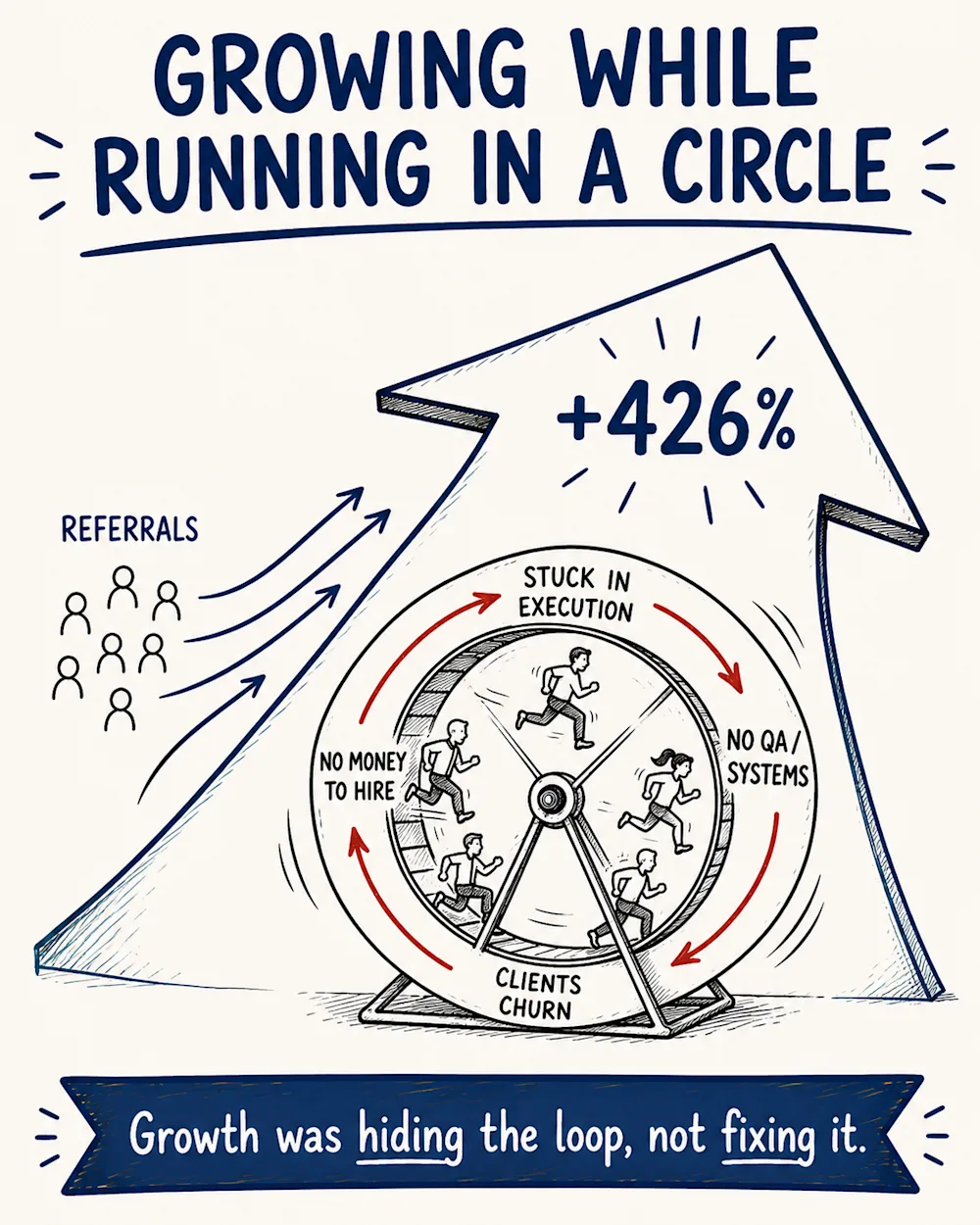
That is the trap. Growth feels like proof that everything is fine. It is not. If your growth is really coming from referrals, one big client, or your own personal hustle, you may be on a treadmill that just happens to be moving forward for now.
How to find your own loop
You can do this yourself, on the back of a napkin, in about ten minutes.
Write down your three most stubborn problems, the ones that keep coming back no matter what you do. Then, for each one, ask a simple question: what causes this? Write the answer beside it. Then ask it again about that answer, and keep going a step or two.
Now look at where the arrows point. If your three problems trail off in separate directions, you have a list, and you can fix them one at a time in peace. But if they start pointing at each other, if the cause of problem one turns out to be problem three, and the cause of problem three turns out to be problem two, you have found your loop. And you have just learned why none of them ever stayed fixed.
Why you cannot break it one piece at a time
Once you can see the loop, the fix is different, and this is the hard part.
You cannot break a loop by fixing its strongest link, because the circle simply routes around your fix and rebuilds it. A loop only breaks when you hit two or three of its links at the same time, so that when it tries to heal, too much of it is already gone.
For a founder, that is genuinely difficult, and not because you do not understand it. Hitting three things at once takes time and money at the exact moment the loop has left you short of both. That is the honest reason these circles last for years in otherwise well-run companies. It is also the main thing an outside pair of eyes is for: to map the loop you are standing inside, and to find the two or three moves that break it together.
You are not bad at fixing your business. You have just been fixing a loop one piece at a time.
Which problem in your business have you fixed more than once, and what keeps bringing it back?
If your business has that stuck-on-a-treadmill feeling, mapping the loop is exactly what a business diagnostic does, it lays out how your problems connect and finds the few moves that break the circle instead of one link at a time. Two of the most common loops have their own reads worth a look: the one where the founder has to do everything, and the one where a problem hides by spreading across your whole company.