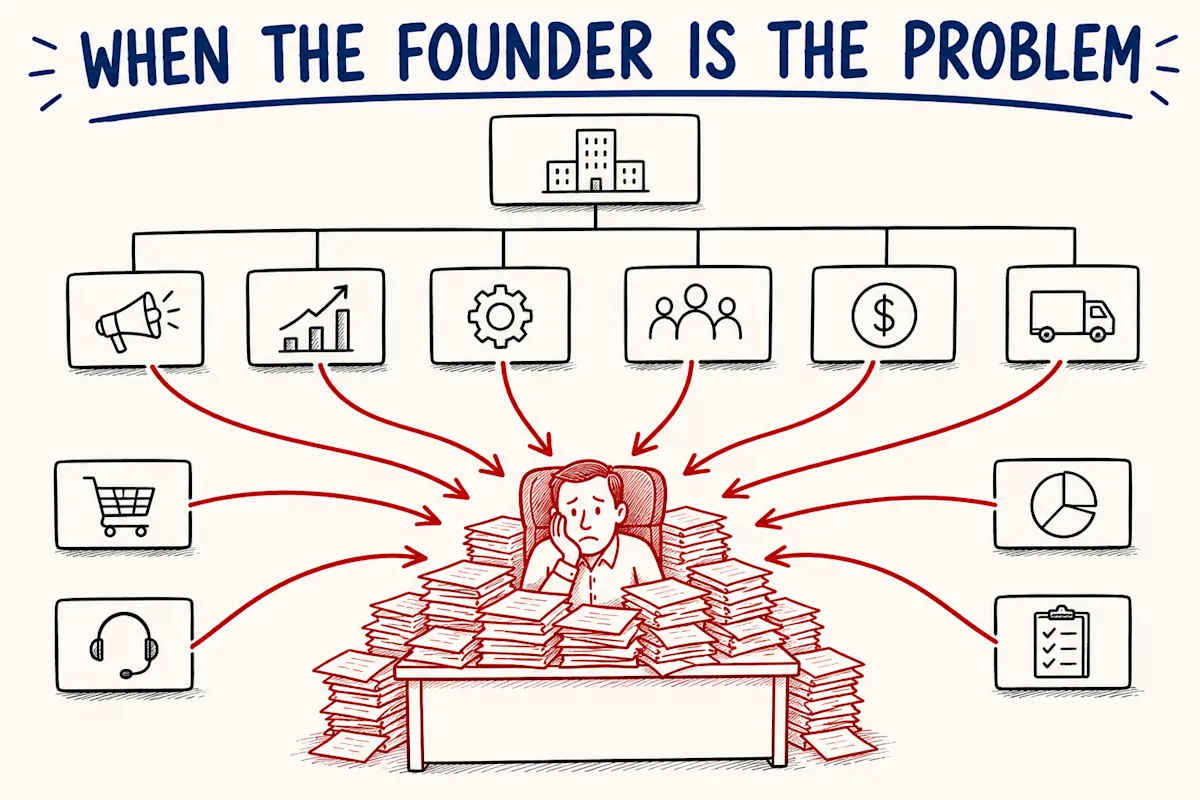
Can Your Business Survive Without You? That's the Wrong Question.
Most owners test their company with "could it survive if I disappeared for a month?" Some can even answer yes. But that is the easier of two questions, and the real one is harder: could it grow without you? Here is the vacation test with both layers, the three signals that you are the bottleneck, and how to fire yourself from operations in the right order, without losing the company you built.
You built this company. In the early years, everything running through you was not a flaw, it was the design, and it was the right design. Your decisions were fastest, your quality bar was highest, your name won the clients. Companies survive their first years precisely because a founder holds everything personally.
Then the company grew. And the design quietly stopped fitting.
Here is how you notice: you have not taken a real holiday in years. Every approval waits for you. Your phone is the sales department. And when you do get away for a few days, you come back to a queue of decisions nobody dared to make. None of this means you failed. It means the company outgrew a design that once served it, and nobody sent you a memo.
I ended up co-writing a whole book about this pattern, Success Ceiling Breakthrough: the strategies that get you to success are rarely the ones that take you past it. Your way of working built the company. Now it may be the ceiling on it.
The vacation test, and its two layers
The classic self-test is one question: what happens if you disappear for a month?
Most owners think the question is about survival, and some can honestly pass it. The work gets delivered, the invoices go out, nothing burns down. If that is you, you have done real work already, and plenty of owners cannot say the same.
But survival is the easier layer, and it is the wrong place to stop. The real question is the second one: would the business grow without you? Not coast, grow. Would anyone develop the offer, open the partnerships, chase the next market, if you were not in the building?
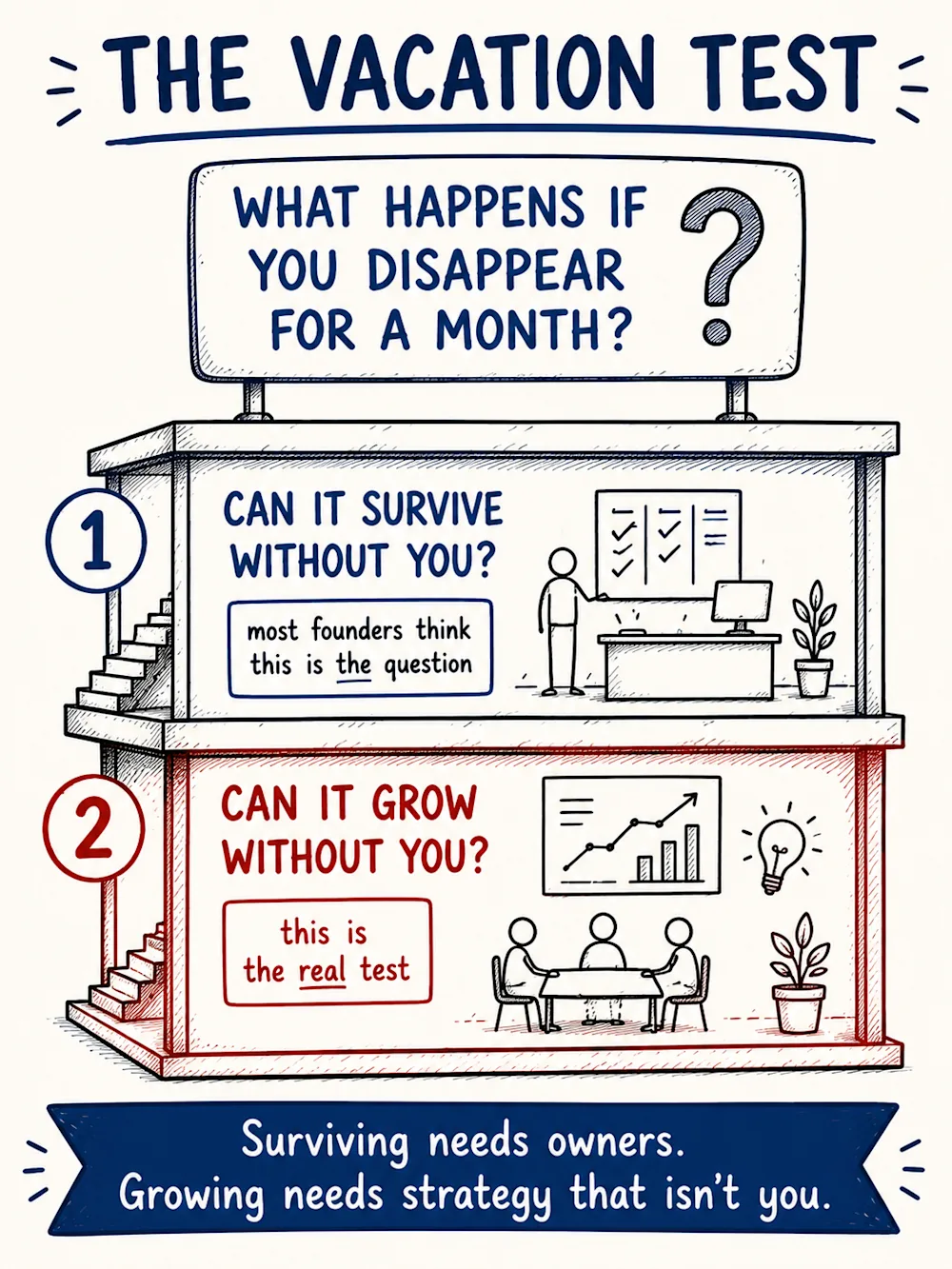
I failed that second layer myself. In Success Ceiling Breakthrough, which I co-authored with Joe Kapp, I documented exactly these two questions. Could my agency survive without me? Yes: marketing brought prospects, salespeople closed, a team delivered. Could it grow without me? All the strategic work, the service development, the partnerships, the direction, was me. "I can probably get there, but I am not there yet" was the most honest answer I could put on the page.
The two layers tell you which kind of dependency you have. Fail the first and it is operational: visible, painful, but at least everyone can see it. Pass the first and fail the second and it is strategic: the quiet kind, where everything looks delegated, the machine hums, and growth is still capped at exactly the size of your own calendar.
What it actually costs you
It is tempting to shrug this off. The company works, you like the work, why change anything? Three reasons, in rising order of pain.
Every fix you make grows back. Founder-dependency regenerates other problems. No documented processes, because everything lives in your head. No sales system, because you are the sales system. You can fix each of those separately for a year and change nothing, because they all grow back from the same root.
Your growth is capped at your calendar. The company can only grow as fast as you can personally push it. Every new client, initiative, and market costs your hours, and your hours stopped scaling years ago.
You own a job, not an asset. This is the one that stings. A business that only works with you inside it cannot be stepped away from, cannot be handed over, and cannot seriously be sold, because a buyer would be buying your obligation to stay. I wrote about this in A Journey to Financial Freedom: the whole point of building a company is that one day it works for you, and a founder-dependent company never does.
Three signals you can check this week
You do not need a consultant to find out. The evidence is in your own systems.
The approval trail. Pick any recent decision, a hire, a discount, a purchase, and trace where it went for sign-off. Now pick five more. If every trail bends toward your desk, you have your answer.
The revenue list. Write down your top ten clients and, next to each, where they came from. Count how many are your personal relationships. If it is seven or more, the revenue does not belong to the company. It belongs to you, and it retires when you do.
The travel test. Look at the last week you were genuinely away. What moved without you? In a founder-dependent company the honest answer is: nothing important.
Fire yourself, in the right order
The fix is not "delegate more." It is a sequence, and the order is what makes it work.
Start with fulfillment. Move the doing off your desk first. It frees the most hours the fastest, and a full-time person on a task will eventually outperform you giving it two hours a day.
Then project management. Hand over the coordinating, so the doing no longer needs your daily steering.
Then sales and marketing. The step you will resist hardest, because it means the revenue stops being your personal relationships and starts being a system the company owns. This is also the step that turns your business back into an asset.
Vision stays. That is not the leftover. It is your actual job, and the whole sequence exists so you can finally do it.
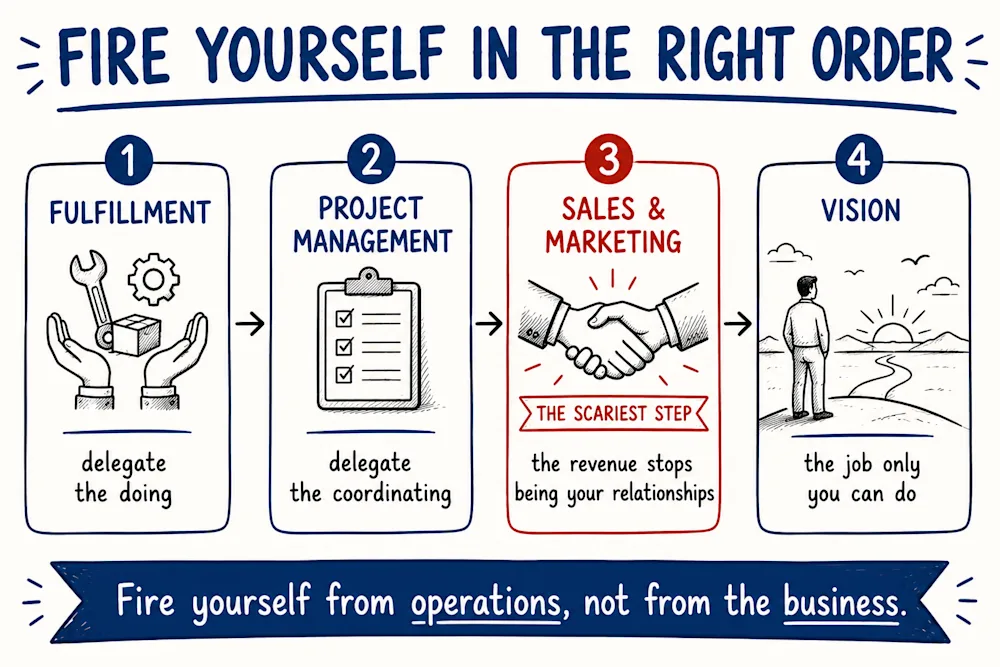
Underneath the sequence sits the checklist that makes it stick: decision rights pushed down, weekly metrics so you can see without touching, documentation so knowledge leaves your head, and a leadership layer so the structure holds on its own.
At my own company we went one step further and built independence into hiring itself. Every new person at BizzBee heard the same rule: you have three months to learn to work without my assistance. We promoted from within, Hristina and Nikolina grew into project managers, Natasha grew into COO, and eventually I stepped down as CEO and handed her the company. It kept running. That is not a story about leaving. I did not lose the company. I finally got the job I founded it for.
Fire yourself from operations, not from the business.
So, honestly: would your business grow without you? And if the answer is "not yet", which of the four steps have you been avoiding?
If you suspect the stubborn numbers in your business trace back to your own chair, that is exactly what a business diagnostic is built to find out, it follows the evidence (the approvals, the revenue, the handoffs) wherever it leads, even when it leads to the founder. And if you want to understand why problems like this are so hard to see from inside, read the problem you can't find is hiding in one of two places.