The Problem You Can't Find Is Hiding in One of Two Places
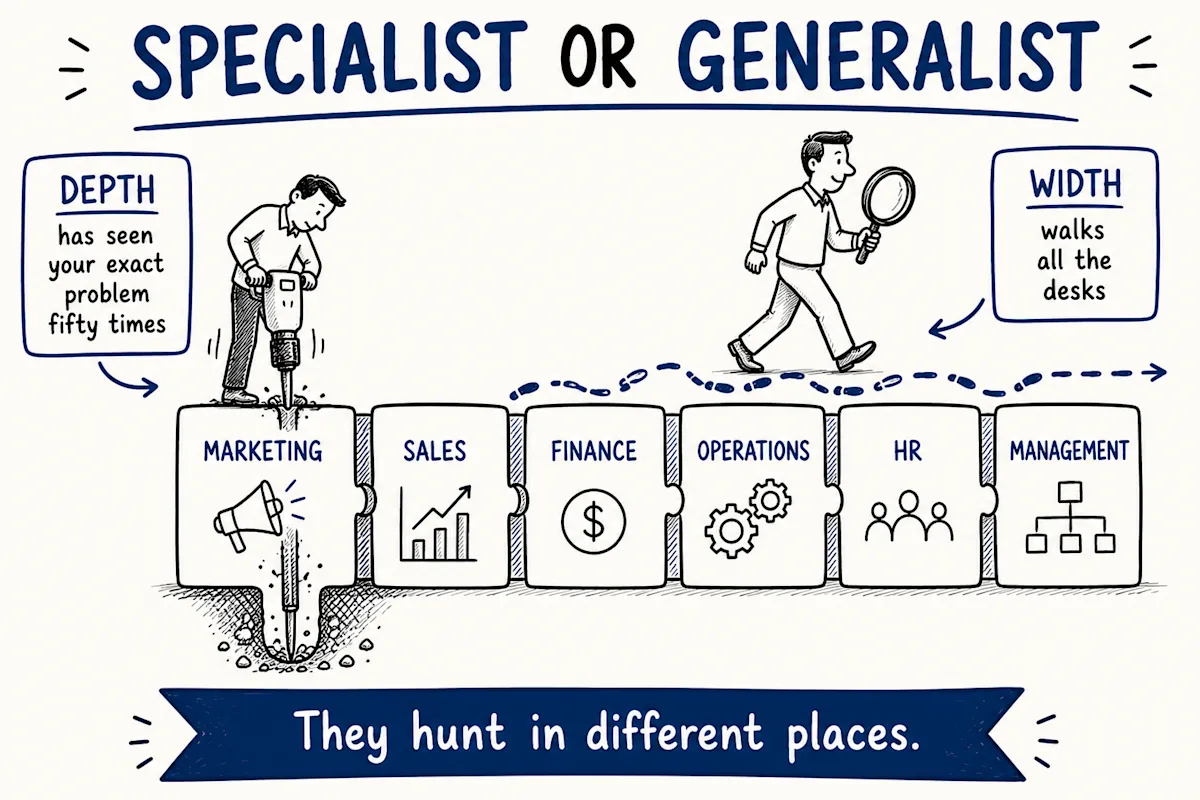
You have already fixed every problem you could see, that is what owners do. So whatever is still hurting the business is hiding, and it hides in one of two places: deep inside one department, or wide across several. Where it hides decides what kind of consultant you need, a specialist or a generalist. Here is how to tell, before you spend money on the wrong one.
Nobody knows your business like you do. And you fix it every day: a broken process, a wrong price, a supplier who slips. Seen, fixed, forgotten. That is what owners do, and you are good at it.
Which makes the thing that is still wrong all the more frustrating. A number that refuses to move. A margin that keeps thinning. Growth that stalled and will not restart. You have looked, more than once, and you cannot find it.
Here is the truth that should take the frustration away: if you could see it, you would have fixed it already. The problems that survive you are, by definition, the ones that hide. And after years of running business diagnostics, I can tell you they hide in only two places.
Hiding place one: deep inside one department
Some problems bury themselves inside a single department, below your own expertise.
You know where it hurts. You can name the department and the number. Conversions on the website dropped and nobody can say why. Scrap on one production line keeps creeping up. The ad account spends more every month for the same result. You can point straight at the problem. You just cannot reach it, because reaching it takes a depth in that one craft that you were never supposed to have. You built a company, not a career in conversion optimisation.
For this kind of problem, the answer is a specialist: the person who has seen your exact problem fifty times in fifty companies. Inside that one box, nobody goes deeper, and depth is what the fix requires.
Hiding place two: wide, between your departments
The other problems do something sneakier. They stretch themselves across departments, into the spaces between desks, where no org chart looks and no manager is responsible.
This is the kind that defeats an owner's repair instinct completely, and it is worth understanding why. Each of your departments, checked on its own, is fine. Each manager, asked honestly, tells you their area is under control, and they are right, about their slice. Every report on your desk is green. The problem does not live in any of the reports. It lives between them, in the handoffs. There is no chair in your building from which it can be seen, including yours, because from your chair you see totals and averages, and averages are where wide problems go to hide.
I wrote up the cleanest example I know in ICMCI's white paper Navigating the Storm: a wholesale distributor with dead inventory quietly piling up on the books. Traced properly, that one pile crossed six desks. Procurement was buying on supplier incentives rather than demand. Sales had no clearance pricing to move old stock. Nobody's KPIs mentioned inventory. Finance was not watching the stock-to-sales ratio. Management had no product lifecycle process. The warehouse ran no ageing reviews. Six departments, six honest "we're fine"s, one problem that had survived for years, in a well-run company, under a smart owner.
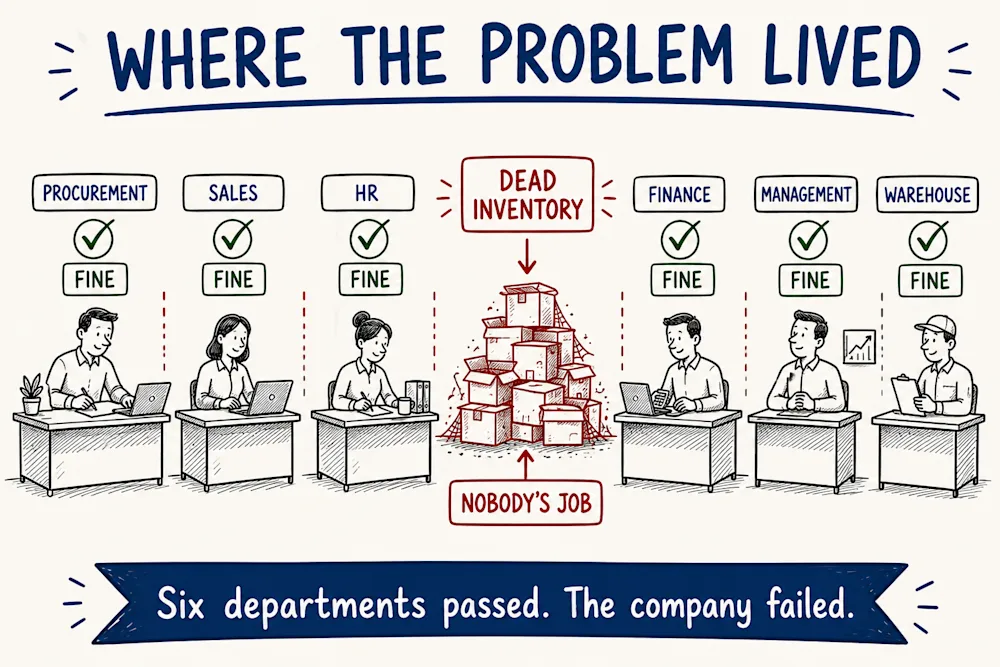
For this kind of problem, a specialist cannot help you, through no fault of theirs: every specialist looks inside one box, and inside every single box, things look acceptable. This is generalist territory, someone hired to walk across all the desks at once. That walk has a name: a business diagnostic.
The expensive mistake: hiring for the symptom's address
Here is where owners lose real money, and it is worth slowing down for.
A problem always shows its symptom at one address. Dead stock shows up in the warehouse. Falling revenue shows up in sales. So the instinct is to hire help for that address: an inventory-clearance expert, a sales trainer, a marketing agency. It feels precise. It is often exactly wrong, because the symptom's address is not the problem's address. The distributor could have hired the best warehouse consultant in the country, and the pile would have grown back, because five of its six causes were never in the warehouse at all.
If this sounds familiar, it is the same law I wrote about in why more sales won't save a broken business: pushing harder at the place where the pain shows does not touch the place where the problem lives.
The test you can run yourself, before you hire anyone
You do not need a consultant to work out which hiding place you are dealing with. You need one question, asked stubbornly: what causes this?
Take the number that will not move, and trace it. Conversions are down, why? The landing pages changed, why did nobody catch it, because there is no testing routine, because nobody owns analytics. Notice what the trail did: it went down, deeper and deeper into one department, getting more technical with every step. That is a deep problem. Hire the specialist with the deepest experience in exactly that area, and let them work.
Now trace the dead stock the same way. The pile exists, why? Purchasing keeps arriving that nobody asked for, why? Buying is driven by supplier bonuses, and old stock never gets discounted, and no one's targets mention inventory, and finance's reports do not show ageing. Notice the difference: the trail went sideways, crossing desk after desk. Nobody inside the company can chase it, because everybody owns one desk and the trail refuses to stay on any of them. That is a wide problem, and it needs a diagnostic: one pair of outside eyes walking the whole trail, then fixing all its causes together, not one desk's worth.
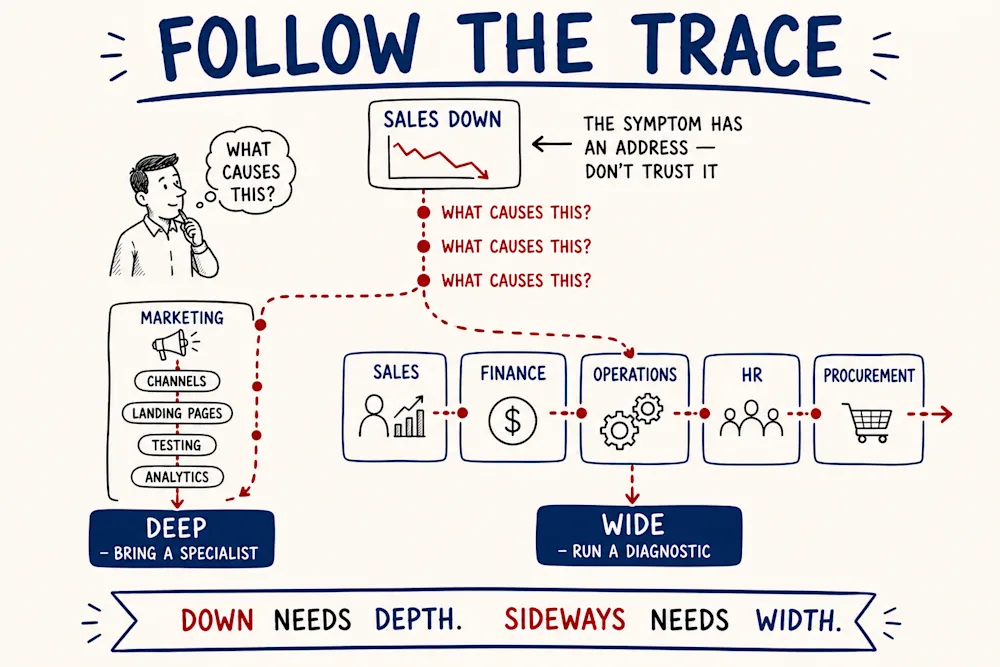
The direction of the trail is the answer. Down means deep, and deep needs a specialist. Sideways means wide, and wide needs a generalist. Get this one read right and every euro you spend on help afterwards lands on the actual problem.
You fixed everything you could see. What is left is hiding, deep or wide. Find out which, before you pay anyone to dig in the wrong place.
Which number in your business has refused to move the longest, and have you ever actually traced it?
At Business Pulse, the wide problems are exactly what we hunt. Our business diagnostic walks every desk in your company and traces the stubborn number back to all of its causes, not just the loudest one, so you fix it once instead of watching it grow back. And if the stubborn number is sales, start here: more sales won't save a broken business.