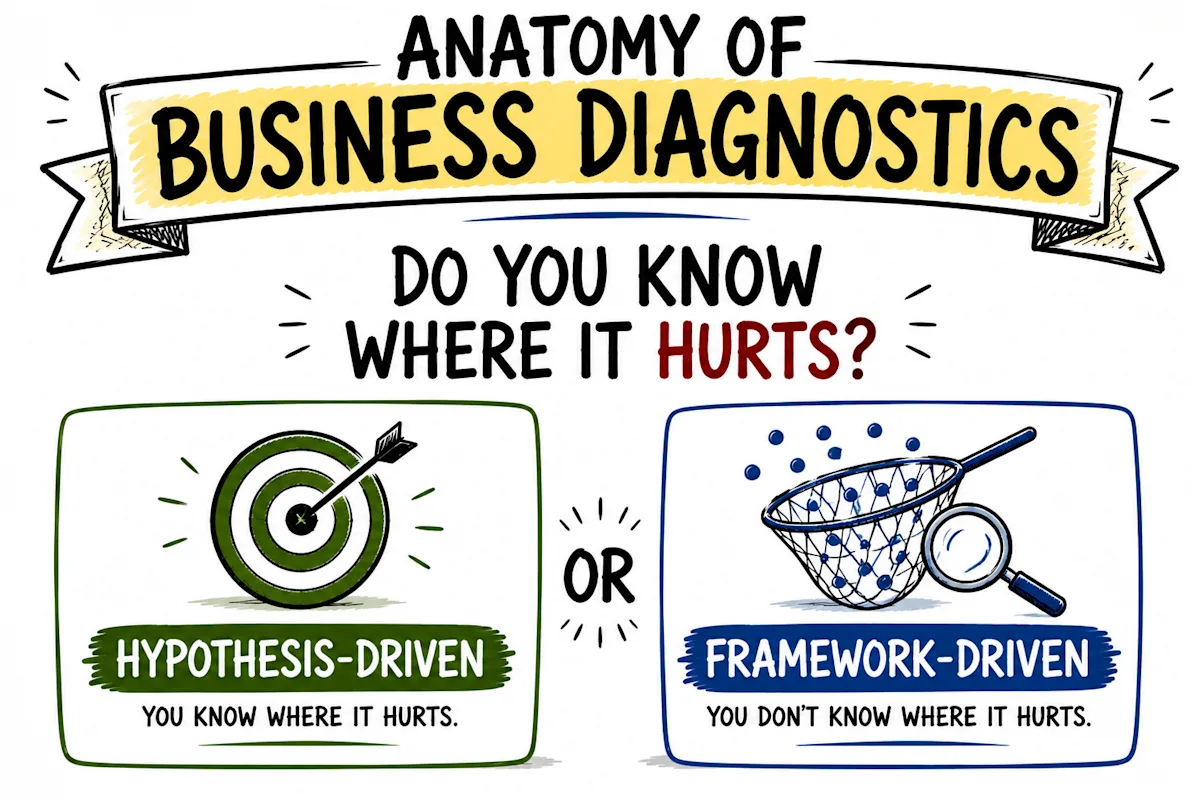
Do You Know Where It Hurts? Two Ways to Run a Business Diagnostic
Some business problems you can point to. Some you can only feel. The first kind calls for a diagnostic that starts with a hypothesis and goes straight for the cause. The second calls for one that starts with a framework and explores broad to find it. Here is how to tell which one your business needs.
When I wrote my earlier blog about why a business diagnostic starts with a hypothesis, one reply kept coming back. Different words each time, the same point underneath: "That all assumes I know where the problem is. What if I don't? What if I just feel that something is off and cannot say what?"
It is a fair challenge, and it deserves a proper answer. Because the honest truth is that starting with a hypothesis is the right move only some of the time. There are two ways to begin a diagnostic, and which one is right turns on a single question: do you know where it hurts?
Two ways to start, and one question that decides
Think about how a good doctor works. If you walk in and say "my right knee hurts when I climb stairs," they do not order every test in the building. They have a hypothesis, and they go straight at it: bend the knee, press here, one scan. Fast, cheap, and aimed.
But if you walk in and say "I just feel run down and I cannot say why," there is nothing to aim at. So they do the opposite: a broad panel, twenty markers at once, looking for the thing you could not name. The wide net is how they catch the problem you did not know you had.
A business diagnostic works the same way, and the two modes have names. Here is the difference at a glance.
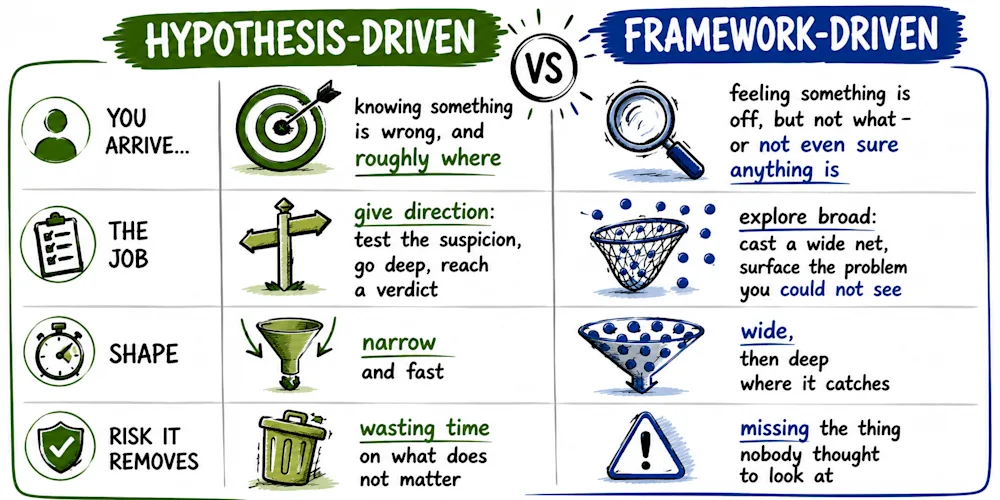
- Hypothesis-driven. You arrive knowing something is wrong, and roughly where. The job is to test the suspicion, go deep, and reach a verdict. It is narrow and fast, and it removes the risk of wasting time on what does not matter.
- Framework-driven. You arrive feeling something is off, but not what - or not even sure anything is. The job is to explore broad, cast a wide net, and surface the problem you could not see. It is wide then deep, and it removes the risk of missing the thing nobody thought to look at.
Neither is better. They answer different situations. Use the wrong one and you waste the engagement. Aim a narrow test at a problem you have not located yet, and you will confirm your hunch while the real issue sits one room over. Cast a wide net when you already know the answer, and you pay for breadth you did not need.
When you know where it hurts: start with a hypothesis
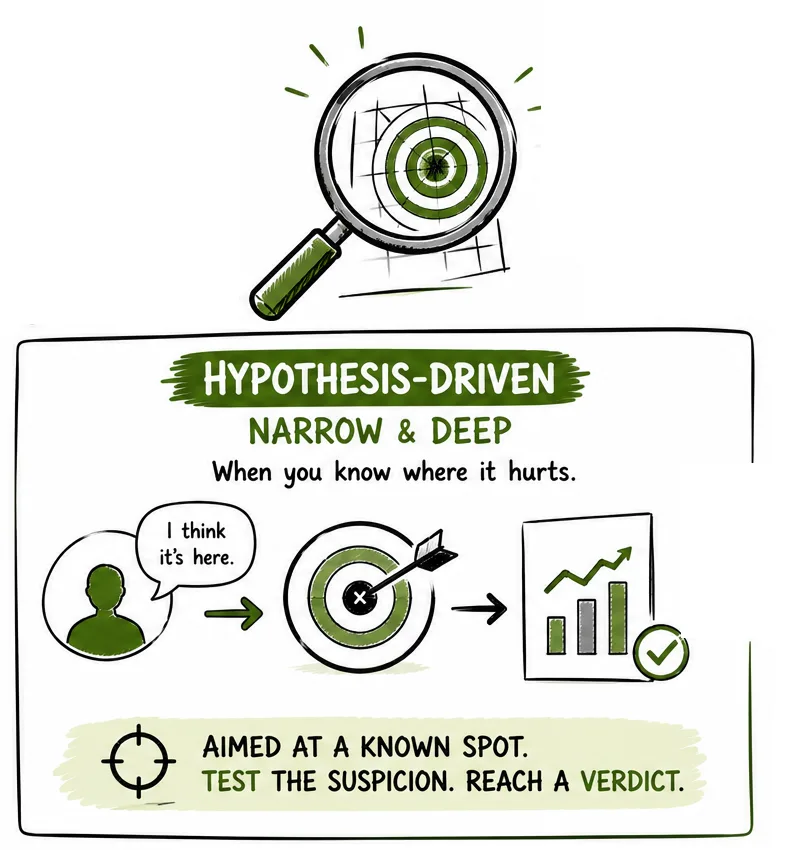
A company that makes and installs windows came to us with three things on its mind, and the owner could name all three. He wanted to win big projects again, the kind he used to land and somehow stopped. He thought his production had a bottleneck at the glass stage that was slowing everything down. And he was tired: every decision in the business ran through him, and he could not step back.
Three felt problems, three clear places it hurt. If that sounds like you, you are in the hypothesis-driven case. When you can already point at the wall like this, you do not need a wide net. What you need is someone to test whether you are pointing at the right spot, because the place you feel the pain is not always the place that is broken.
A good diagnostic turns each of your concerns into a hypothesis, and a real hypothesis is not just a worry, it is a statement someone can prove wrong. Take the bottleneck. The hypothesis is not "the glass stage is slow." It is sharper: "the glass stage is the limit on output, because the cutting is manual and cannot keep pace with the rest of the line." Put that way, it says exactly what evidence would confirm it and, just as important, what evidence would kill it. Maybe the glass is not the constraint at all. Maybe the machines have plenty of room and the real limit is demand - not enough big projects coming in to keep them busy. You want a diagnostic that is willing to find that out, not one that just nods along with your first guess.
Here is the quiet payoff for you. Once the hypothesis is sharp, the questions narrow on their own. How many big projects have you won lately, and how did they come in? Where does your capacity actually run out, not just where you assume it does? How many hours a week go on decisions only you are allowed to make? A good diagnostic will not drag you through every department - it asks the few things that test your three suspicions and leaves the rest of the business alone. That is what makes this kind of diagnostic fast, and it is what you should expect when you already know where it hurts: do not pay someone to rediscover it.
When you don't know what to look for: start with a framework
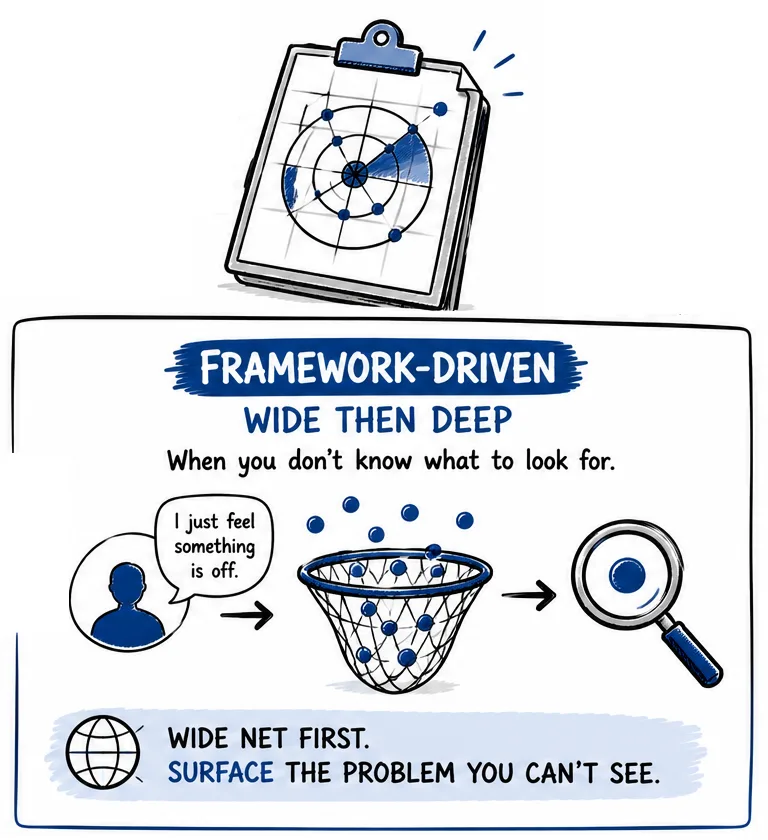
Now the opposite case. Sometimes you cannot point to where it hurts. Maybe something feels off and you cannot say what. Maybe you are stepping somewhere new and do not even know what matters there yet. Either way you cannot form a sharp hypothesis, because you do not yet have the question. This is when you reach for a framework: a ready-made map of what to look at, so you can explore broad and let the real issue show itself.
The cleanest version of this is an established framework doing exactly that job. A retailer came to us wanting to open in a neighbouring country. The goal was clear; everything else was fog. They did not know the suppliers, the customers, the competitors, or how hard it would be to win a foothold - so they could not tell us what to worry about first. There was no hypothesis to test, because they did not yet know the terrain.
So we reached for one of the oldest lenses there is: Porter's Five Forces. It is a fixed set of five questions you can ask about any market - how much power the suppliers hold, how much power the customers hold, how fierce the existing competition is, how easily new players can enter, and what substitutes could take your place. Run those five against the new country and a blank map turns into a real picture: how attractive that market actually is, and where the danger sits. The framework did the thing the client could not. It supplied the questions. That is what a good framework is - not a verdict, but a complete list of what to examine when you do not yet have your own.
Sometimes no off-the-shelf framework fits, so you build one. A kids-education centre came to us wanting to turn one successful location into a franchise. The owner was proud of what she had built, and rightly so. But she had a worry she could not put into words: she was not sure the thing she was about to franchise was actually strong enough to hand to someone else. Something felt missing. She just could not say what. When we asked what to fix, she could not point to it - what she could do was hand over everything she had built: the curriculum, the awards, the parent community, even the centre's own song.
There was no ready-made "is this franchise-ready?" framework to reach for, so we made one - a complete picture of what a franchise actually needs in order to be sold and run by someone else, laid out as ten documents across three layers: how it is sold, how it is run, and what the educators use day to day. Then we graded her business against every element of it. Not "what is wrong," because nobody knew yet, but "how much of a complete franchise is already here, piece by piece?"
That wide net caught exactly what no hunch would have. She scored beautifully on the things she had poured herself into - the teaching method came back close to complete. And she scored near zero on the one thing a buyer actually decides on: there was no financial story at all. No pricing logic, no unit economics, nothing to show a future franchisee they would make money. That was the missing piece she could feel but could not name. The framework found it precisely because it looked everywhere, including the places she had no reason to suspect.
That is the whole case for the wide net, whether the framework is one you pull off the shelf or one you build for the question. If either of these sounds like you - heading somewhere new, or unsure whether what you have is as solid as it looks - this is the diagnostic you need, and a hypothesis-driven one would quietly skip the very thing that matters. (The franchise is the engagement I took apart in detail in grading a franchise against a tailored framework, if you want to see the grading itself.)
You do not actually choose one forever
Here is where the two ideas seem to fight, and where they actually settle.
If you read the first piece, you might have heard me say: start from a sharp hypothesis, ask only what tests it, and leave the rest in the drawer. That is good advice, and taken too literally it is dangerous - because if you only ever ask what your hunch already suspects, you can never catch what you did not suspect. The franchise's missing financials, the symptom that turns out to be something else entirely: a pure hypothesis walks straight past them.
So the real rule is not "hypothesis or framework." It is depth from one, breadth from the other.
The hypothesis decides where to dig deep. The framework keeps a wide net running underneath, so something can still surprise you. So even when your diagnostic is built around your three concerns, a good one still runs a light scan across the rest of the business - quick, shallow, cheap. Most of the time it finds nothing. But every so often that scan trips on something you never mentioned, and the moment it does, it stops and digs. That light scan is not wasted money. It is the entire reason a problem you never suspected gets caught at all, which is why it is worth checking that the diagnostic you buy actually does it.
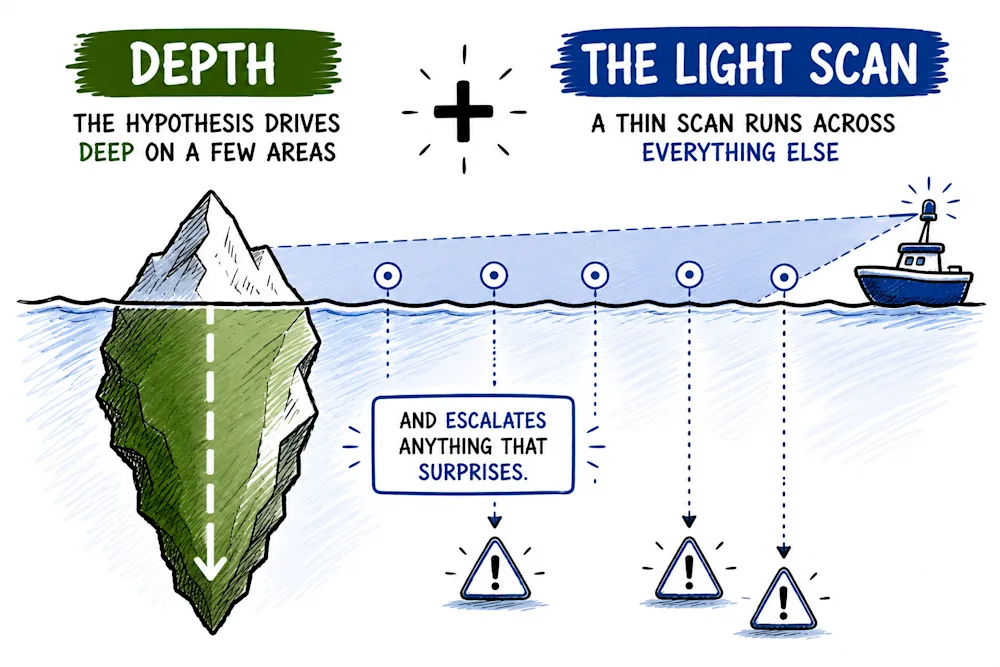
It is the doctor again. The targeted test for the knee, yes. But also the standard panel running in the background - not because anyone suspects diabetes, but because that is how diabetes gets found in a patient who came in about a knee. No competent doctor cancels the panel just because there is a presenting complaint. So when I said "leave the rest in the drawer," the correction is small but it matters: leave the rest light, not gone.
So which situation is yours?
Most owners can place themselves with one honest sentence about how much they already know. Here is the split.
You probably need the broad, framework-driven start if:
- Something is not working and you cannot find why. Revenue is sliding, or you just took over, and the things that used to work do not anymore.
- You are making decisions in the dark. You do not really trust your numbers, and you hesitate when someone asks how the business is doing.
- You do not know what to fix first. You have a list of problems and a list of opinions, and you need evidence to say which one actually matters most.
You probably need the focused, hypothesis-driven start if:
- Everything depends on you. You know the problem - the business cannot run without you in the room - and you want a way out.
- You need more clients. You know where it hurts; you just have no system to fix it.
- AI and technology are passing you by. You know the gap; you need a path into it.
The cases above sit on each side. The window-maker knew his three pains, so we tested them. The retailer and the franchise owner could not yet say what to look for, so we handed them a framework and went looking. Same instrument, different starting points.
One honest wrinkle: the labels are a guide, not a law. "Deciding in the dark" sounds like the broad case, but if an owner can say plainly "my problem is I have no financial visibility," that is a where, and we can start with a hypothesis about it. What decides the mode is never the label. It is whether you can point to where it hurts.
What to do before you buy any diagnostic
Before you commission a diagnostic, ours or anyone's, work out which of the two you are buying. Ask yourself the one question: can I point to where it hurts?
If yes, you want a hypothesis-driven diagnostic that goes straight at it and does not bill you to rediscover what you already know. If no, you want a framework-driven one that explores broad before it commits. And whichever it is, make sure the broad one still narrows to a verdict, and the narrow one still keeps a light scan running for surprises. A diagnostic that does one without the other is half an instrument.
Get the starting point wrong and the whole engagement is aimed at the wrong thing, however well it is run.
At Business Pulse, the first thing we work out with you is exactly this: do you know where it hurts, or do we need to go find out? The business diagnostic is built either way - hypothesis-led when you can point to the problem, framework-led when you cannot. If you want the groundwork, here is why a diagnostic starts with a hypothesis, and the franchise we graded against a tailored framework.
When you think about your own business right now - can you point to where it hurts, or do you only feel that something is off?