The Depth Behind Real Consulting Advice: Grading a Franchise Against a Tailored Framework
A great business spots a new opportunity - say, turning its success into a franchise - and hires a consultant to help capture it. Get generic advice, though, and you can pour months and money into the wrong move and miss the opening. Real advice is the opposite: researched, measured, specific. Here's a look inside one engagement: a tailored framework I built to test whether a kids-education center was ready to franchise, and the element-by-element grading behind the answer.
Picture a business that genuinely works. A proven product, happy customers, steady growth, and a founder who can now see a bigger opportunity: take what works here and expand it. Franchise the model, and grow well beyond a single city.
It's an exciting moment, and an unfamiliar one. So you do the smart thing and bring in a consultant to help you capture it, which isn't a small act. It's money you could have put into the expansion itself, and it's hope: that someone with more experience will help you seize the opportunity the right way.
Here's the risk worth naming. Most consultants genuinely want to help, but if the advice turns out to be generic - an opinion off the top of someone's head, or a quick search dressed up in a slide deck - you can apply it in good faith and pour real money and months into the wrong move. At a moment of opportunity, that's the expensive part: not the fee, but the opening you burn chasing something that wasn't ready, or building in the wrong order. A few consultants lean on that kind of surface-level advice, and it colours how people see the whole craft.
Real consulting is the opposite: researched, structured, measured, and built around your specific situation. The clearest way to show what that looks like is a real example. Recently I worked with a proven kids-education center that wanted to turn its success into a franchise and sell the model to others. Here's how that work actually looked under the hood.
The honest first question
Before you help anyone sell a franchise, you have to answer an uncomfortable question: is it actually a franchise yet? A great program is necessary, but it is not the same thing as a franchise-ready package that a stranger can buy, open and run in another city.
The catch is that there's no neat, off-the-shelf yardstick for "franchise readiness" in early-childhood education. So rather than eyeball a strong curriculum and offer an opinion, I built the measuring instrument first.
Depth move 1: build a tailored framework
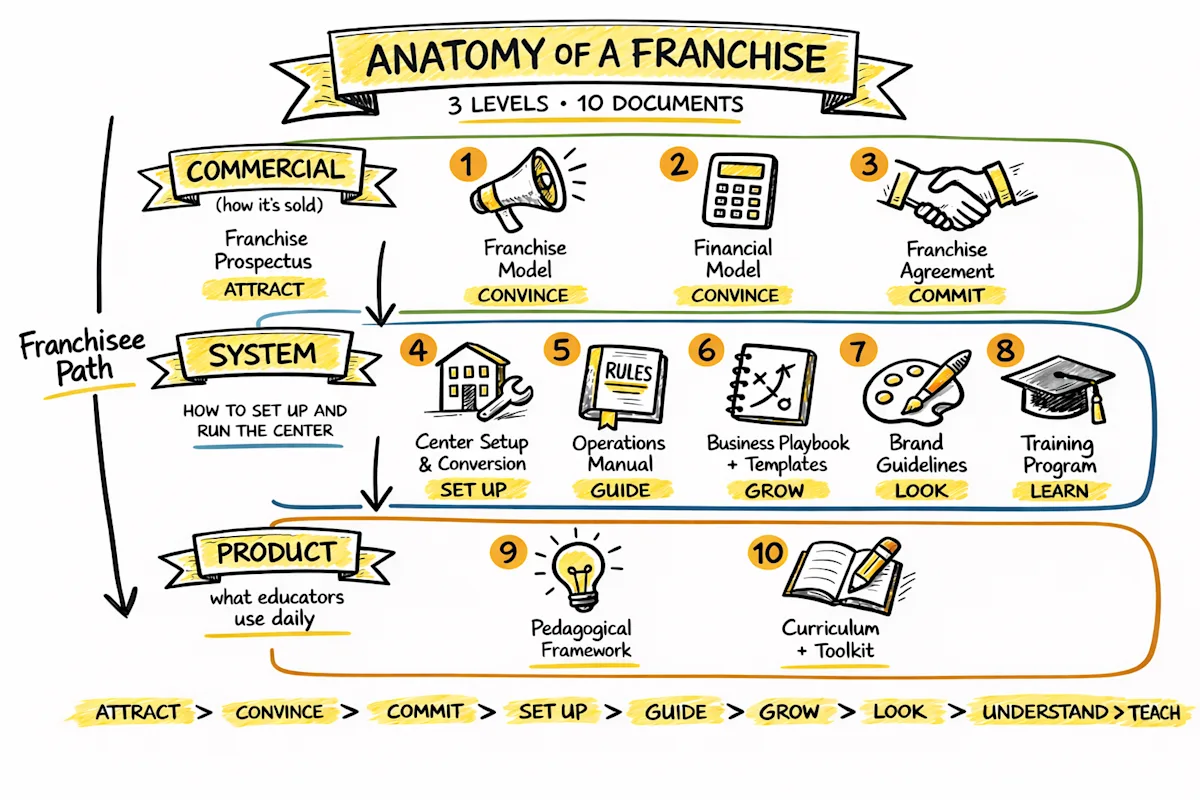
Drawing on years of consulting experience and a deep look across multiple existing kids-center franchises, I mapped the pattern behind what a successful franchise actually looks like. From that, I created a tailored framework for exactly this job, which I call the Anatomy of a Franchise. It defines the 10 documents a complete franchise package must contain, grouped into three levels and ordered by the franchisee's journey from first interest to running a center:
- Level 1, Commercial (how the franchise is sold): Franchise Prospectus (attracts), Financial Model (convinces), Franchise Agreement (commits).
- Level 2, System (how to set up and run a center): Center Setup and Conversion Guide, Operations Manual, Business Playbook and Templates, Brand Guidelines, Training Program.
- Level 3, Product (what educators use every day): Pedagogical Framework, Curriculum and Toolkit.
The tailoring is deliberate. A generic franchise checklist would miss what makes an early-education franchise specific: the pedagogy and curriculum that sit at the heart of the product. Building the framework for this exact case is the difference between a real answer and a borrowed one.
Depth move 2: grade the document against it
With the tailored framework in hand, I took the company's actual program document and graded it element by element, assigning a coverage percentage to each of the 10 documents. Numbers, not impressions. The pattern was striking:
- Product: excellent. Pedagogical Framework 95%, Curriculum and Toolkit 80%.
- System: thin. Operations Manual 60%, but Business Playbook 20%, Center Setup 15%, Brand Guidelines 15%, Training Program 10%.
- Commercial: almost empty. Franchise Prospectus 10%, Franchise Agreement 5%, Financial Model 0%.
One view told the whole story: a world-class teaching product, and almost no franchise. Everything needed to teach children beautifully was there. Almost nothing needed to sell the model, protect it legally, or help a stranger replicate it was.
Depth move 3: say exactly what is missing
This is the part that separates a real audit from a report card. A grade on its own is just judgement. The value is in showing, for every element, precisely what exists and precisely what has to be built to reach 100%. A few examples:
- Financial Model (0%): nothing existed. Needs setup costs for a new center versus a conversion, a projected P&L by month and year, a break-even timeline, the franchise fee and royalty structure, and an adjustable planning spreadsheet built from real operating data.
- Franchise Prospectus (10%): there was a short "about" section and a philosophical foreword, but no actual pitch document, no competitive positioning against other early-education franchises, no social proof, no package overview, no investment highlights, no target-franchisee profile. It read as a teaching manual, not a sales tool.
- Operations Manual (60%): strong on org structure, daily schedule and mandatory events, but missing the unglamorous essentials: health and safety protocols, staff-to-child ratios, fee collection, regulatory compliance, and the franchisor's audit and escalation process.
Every one of the 10 elements got that treatment: what is there, what is missing, what to build. The output isn't "you're at roughly 40%." It's a precise, prioritised construction plan to get from a great program to a sellable franchise. And the audit was only step one of a sequenced engagement: grade the offer, then map the competitors, then study the market, then define and tailor an offer to each validated buyer profile. Depth at every step.
Why the depth matters
Here's what that depth actually protected. Generic advice, in this case, might have been easy and flattering: "your program is excellent, you're ready to franchise, go sell it." Follow that, and the founder could spend the next six months and a real budget marketing a franchise that didn't exist yet - taking meetings, fielding interest, watching it stall, unsure why. The tailored framework didn't just produce a tidy grade. It helped avoid an expensive wrong turn, and replaced it with a clear, ordered list of what to build first.
Notice what else didn't happen. I didn't glance at a strong curriculum and say "looks franchise-ready to me." I didn't search "how to franchise a business" and hand over a generic listicle. The honest answer, that they had a brilliant product and roughly 5% of a commercial package, only became visible because there was a tailored framework to measure against and the discipline to grade every part of it.
That's the bar. For a client, it's the difference between confident, specific direction and an expensive opinion. For a fellow consultant, it's the reminder that the work worth charging for is the work you build the instrument for, not the answer you look up. It's the same founder-first rigor behind our diagnostic methodology.
What this means for you
Whether you're a founder choosing an advisor or a consultant setting your own standard, the test is simple: does the advice come from a framework and a measurement, or from a feeling? Real consulting builds the instrument, measures honestly, and hands you a specific way forward.
It's the same depth behind a Business Pulse diagnostic, except there the "document" being graded is your whole business, assessed across operations, finance, sales and people, with a prioritised plan to close each gap. Understand it precisely first. Then act.