Why a Business Diagnostic Starts With a Hypothesis, Not a Questionnaire
A real business diagnostic is not a questionnaire or a data dump. It starts with a hypothesis - the problem or opportunity you actually care about - and turns your data into a verdict. Here is how a diagnostic is built, part by part, and why naming the right question is the part you hire a consultant for.
Most things sold as a "business diagnostic" are one of two things. A questionnaire that gives you a score, or a thick report that tells you what you already knew, in more detail. Both feel thorough. Neither answers the question that made you pick up the phone.
A real diagnostic is a different animal. And the difference starts before any data is collected. It starts with a hypothesis.
It starts with a hypothesis, not a questionnaire
Every business that brings in a consultant arrives with one of two things: a problem they need solved, or an opportunity they want to capture. "Our margins keep getting thinner." "We think we could win the market in the next city." Even the vague "we just want to know where we stand" is hiding one: "we think we are on the right track, and we want that confirmed."
That thing - the problem or the opportunity - is the hypothesis. It is a statement you can confirm or deny. And it is the single most important part of the whole exercise, because it is the spine everything else hangs from.
A diagnostic without a hypothesis is a high-school project. You gather a lot of facts, arrange them neatly, and at the end you have a lot of facts. Every finding is true; none of it is an answer to anything. With a hypothesis, every finding has to earn its place by confirming or denying the thing you actually care about. That is the whole difference between "here is your data" and "here is whether your plan holds up."
The anatomy: what a diagnostic is actually made of
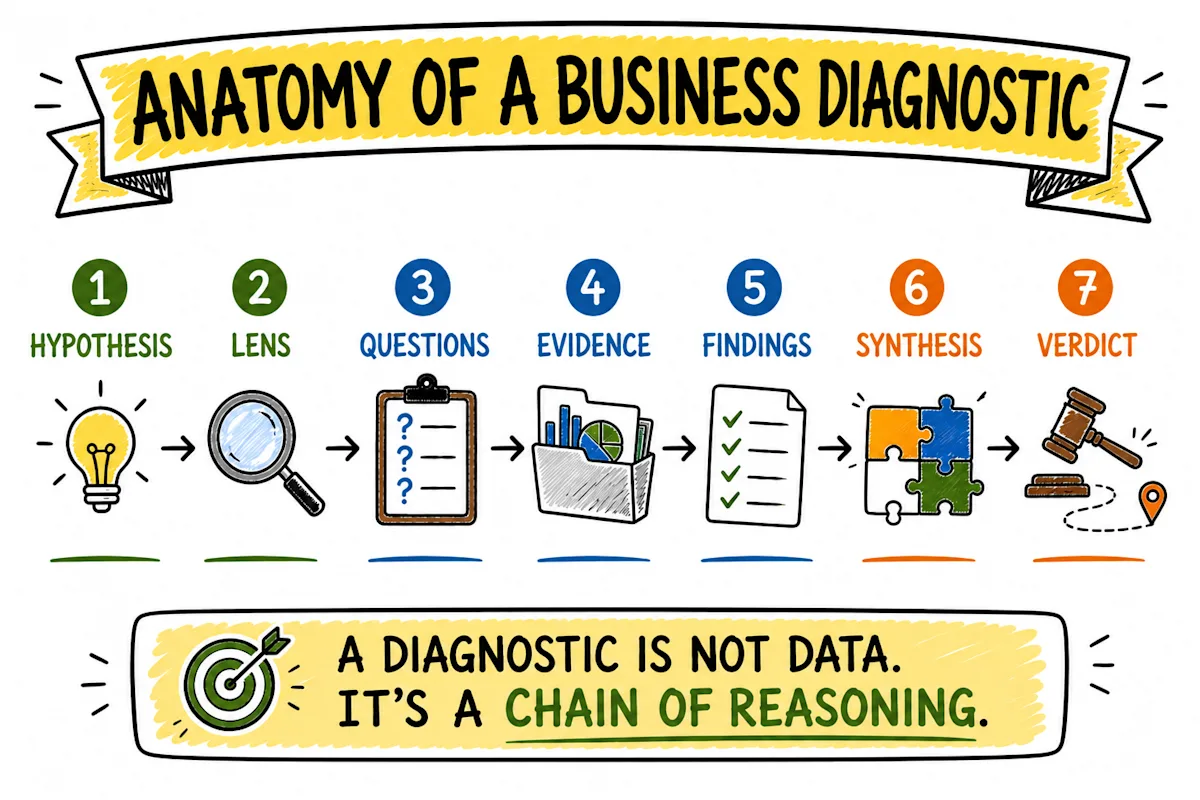
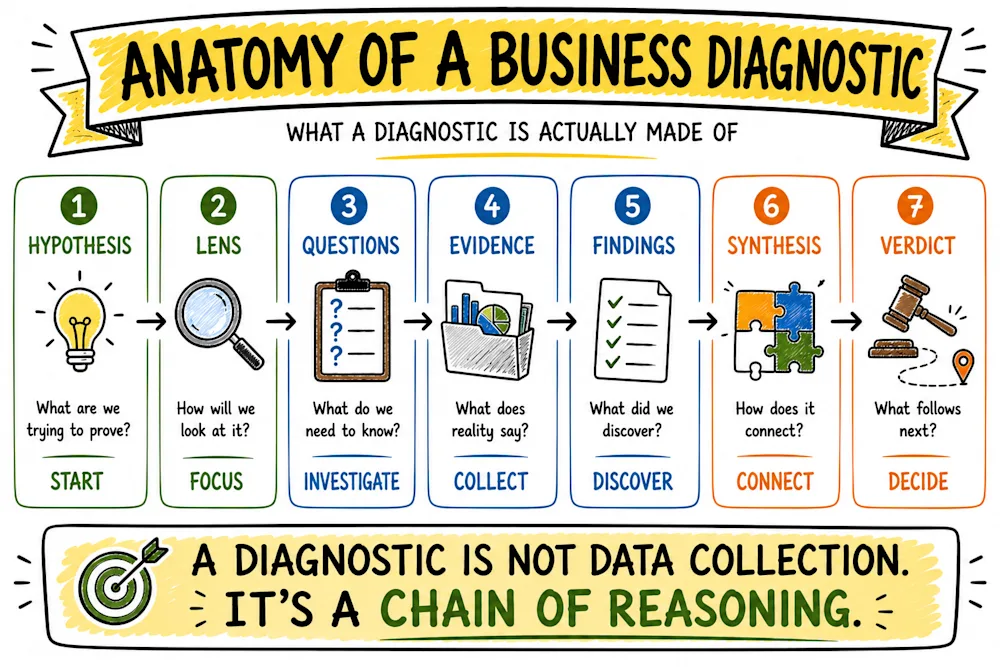
Once the hypothesis is set, the rest is a chain. Every link connects back to it:
- Hypothesis - the problem or opportunity, written as a statement you can prove right or wrong. The craft is in the wording: "we want to grow" cannot be tested, but "our margin is shrinking because our largest client keeps squeezing price" can. A good one names the symptom, a suspected cause, and what evidence would confirm or deny it.
- Lens - the framework you choose because of the hypothesis, to study it from one angle: a SWOT, Porter's five forces, a financial review. The lens is the decision that drives everything below it, because each lens carries its own way of looking. You pick the one, or two, or three, that actually illuminate this hypothesis.
- Questions - these come from the lens, not invented freely. Run Porter's five forces and you get one set of questions (about buyers, suppliers, rivals, substitutes, new entrants); run a SWOT and you get a completely different set. So the purpose runs upward: the questions exist to complete the lens, and the lens exists to give you a view on the hypothesis. Each big question then breaks into smaller, answerable ones.
- Evidence - where the questions meet reality. A question is useless hanging in the air; it has to be answered against real data, and that data comes from two places, because the questions do. Internal data is the company's own performance - finance, operations, sales, marketing, HR - and answers questions about how the business runs. External data is the business environment - market, competitors, industry, regulation - and answers questions about where the business sits. A SWOT makes the split obvious: your strengths and weaknesses come from inside, but your opportunities and threats can only come from outside. Either way, evidence is raw material - facts that do not yet mean anything - and it is the part most businesses already have and mistake for the diagnostic itself.
- Findings - what you get when a question meets the data: an answer, tied to a source, not to an opinion. Two kinds matter: a fact (what the data plainly says) and a conclusion drawn from facts (what those numbers mean together). Every finding either strengthens or weakens the hypothesis; one that does neither does not belong.
- Synthesis - the step where separate findings become one picture, and the step a questionnaire skips entirely. On their own, findings are just a pile. The value appears when you see how they connect: five "separate" problems turning out to be five causes of one. The pattern is the insight.
- Verdict - the report, answering the hypothesis directly: does it hold, fully, partly, or not at all, and what follows. It is a decision plus a short, ordered path, not a binder of everything that could be improved.
Here is the test of whether a diagnostic is sound. Take any recommendation in the final report and trace it backwards: recommendation, to finding, to the evidence behind it, to the question, to the lens, to the hypothesis, to the owner's original concern. If you can make that trip without the chain breaking, the recommendation is grounded. If you cannot, it came from somewhere other than your actual problem, and you should not trust it.
Your frameworks are lenses, not the diagnostic
This is where the famous frameworks come in, and where most people misuse them. A SWOT, Porter's five forces, a maturity score: these are not the diagnostic. They are lenses. You point one at the hypothesis to see a single facet of it.
Take SWOT, since everyone knows it - the same logic holds for any lens, SWOT just makes the cleanest example. Most companies run it the way it gets taught in school, at the level of the whole company, and the result is always the same kind of list. Strength: experienced team. Weakness: marketing budget is tight. Opportunity: the market is growing. Threat: new competitors are appearing. Every line is true, and not one of them is useful. Nobody does anything differently on Monday because of it, so it goes in a drawer. The reason it is useless is that it is pointed at nothing. A lens with nothing to focus on just shows you the whole room, slightly blurred.
Now point that same SWOT at a real hypothesis - "we should open a shop in the next city" - and watch it change. The strengths get specific to the move: "our brand is already known there from clients we serve across the border." The weaknesses start to bite: "we have no supplier or logistics base in that city." The opportunities and threats turn concrete: "no direct competitor in our niche there yet, but the one regional player is rumoured to expand into it next year." Same four boxes, same framework. The only thing that changed is the question it is answering - and suddenly every line is a factor in a decision you are about to make. The hypothesis is what supplies the stakes, and the stakes are what force the answers to be sharp and honest instead of generic.
And because each lens shows only one facet, strong diagnostics stack them on the same hypothesis. On that city question, a SWOT gives you the inside-and-outside read while Porter's five forces tells you how hard the competitive ground will be to hold. Run both, merge them, and you get an answer neither could give alone. The framework was never the point. The hypothesis it serves, and the judgement in choosing and combining the right lenses, is.
What this looks like in practice
A software company once came in with a long list of complaints: no CRM, no real sales process, no financial forecasting, no way to see which projects actually made money, and a founder who personally signed off on everything. A questionnaire would have logged all five as separate problems and recommended fixing each one.
But the hypothesis - the thing actually keeping the founder awake - was one sentence: revenue is unpredictable. Hold those five findings against that sentence and they stop being five problems. They become five causes of one. No pipeline, so you cannot see revenue coming. No project profitability, so you cannot tell good revenue from bad. Founder-dependency, so none of it runs without him.
The diagnostic did not just list the facts. It connected them into an answer: your revenue is unpredictable because nothing in the business is built to make it predictable. That sentence is a verdict. The list was just data.
The report is a verdict, not a binder
Which is the entire point of the exercise, and the place most reports fail. A diagnostic report should not be an encyclopaedia of everything that could be improved. It should take a position: here is whether your hypothesis holds, here is why, and here are the few things to do about it, in order. A verdict commits. A binder hides.
This matters more than it sounds, because a business can only act on a handful of things at once. Hand a small company twenty recommendations and you have handed it paralysis - everything is a priority, so nothing is, and the report ends up in the same drawer as the company-level SWOT. Hand over the three that actually matter, in the order they should be tackled, and they get done. Fewer, connected, prioritised beats comprehensive every time, and the research on this is blunt: businesses given a short, focused list implement far more than the ones handed the exhaustive one.
Cutting twenty findings down to three is not laziness. It is the hardest and most valuable judgement in the whole job. It means saying "this is the thing to fix first," and being willing to be wrong about it. A data dump never has to take that risk, which is exactly why it is worthless: it gives you everything so it can be held responsible for nothing. The verdict is the consultant putting their name on an answer.
And one quiet but important part of any honest verdict: the things the diagnostic could not answer are findings too. If the cash is not tracked anywhere, that is not a hole in the report - it is one of the loudest findings in it. "You cannot see X" is very often the real problem hiding underneath the one the owner first named.
So why call a consultant at all?
It is a fair question, especially now that the frameworks are free and AI will answer almost anything you ask it. The honest answer: the value was never in gathering the data. It is in three things a tool will not do for you.
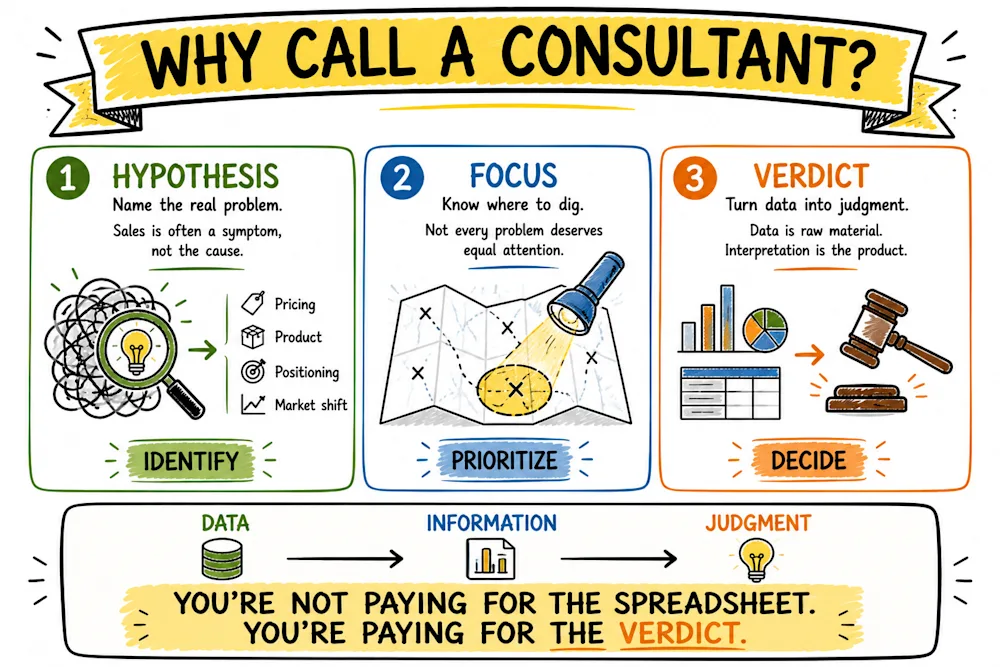
Naming the real hypothesis. Owners almost always misname their problem. "We need more sales" is the classic, and it is a symptom, not a diagnosis. Trace it back and the real issue is usually pricing, or the product, or a market that moved while no one was looking. Fix that, and the sales problem often dissolves on its own. Naming the right hypothesis is most of the job.
Choosing the lens and where to dig. Not every part of a business deserves equal attention. A good consultant spends the depth where the concern actually is and lightly scans the rest, instead of treating all twelve areas as equally urgent.
Turning data into a verdict. In a real diagnostic, every table ends with a line that says, in effect, "what this means." That line - the interpretation, the judgement - is the entire product. The data underneath it is the raw material everyone already has. The verdict is what you are paying for.
That last one is also why this is not getting automated away soon. A machine is very good at answering the question you give it. It is not good at telling you that you asked the wrong question.
So before you commission your next "diagnostic," or fill in another assessment, ask one thing: what is the hypothesis? What problem or opportunity is this actually testing? If no one can answer that in a single sentence, you are about to pay for a data dump.
What is the one question you would want a diagnostic to actually answer about your business?
If that question is the one keeping you up, that is where a Business Pulse diagnostic begins - built around your hypothesis, not a checklist. For the step-by-step version of how it runs, here is the 7-step business diagnostic framework. And if your hypothesis is about AI, here is where AI actually creates value.