Most SMEs Use AI to Cut Costs. The Real Money Is on a Layer Almost Nobody Reaches.
Most SMEs point AI at one job: cutting costs. But there are three layers of AI value, and the richest one - inventing business models that were impossible before AI - is the layer almost everyone skips. Here is why that happens, and how to climb past it.
Every time I speak about AI - most recently at WITCON, the Women in Tech conference - the first hands up ask the same question. Not "how could AI reinvent what we do?" but "how can we use AI to cut costs?" How can we automate this task, speed that one up, do the same work with fewer people.
It is a fair question. It is also the smallest one in the room.
I understand why it dominates. Cost is the part of the business an owner can feel. You can point at it, measure it, and watch it drop next quarter. So that is where almost every AI project starts. The problem is not that it starts there. The problem is that almost every AI project also stops there.
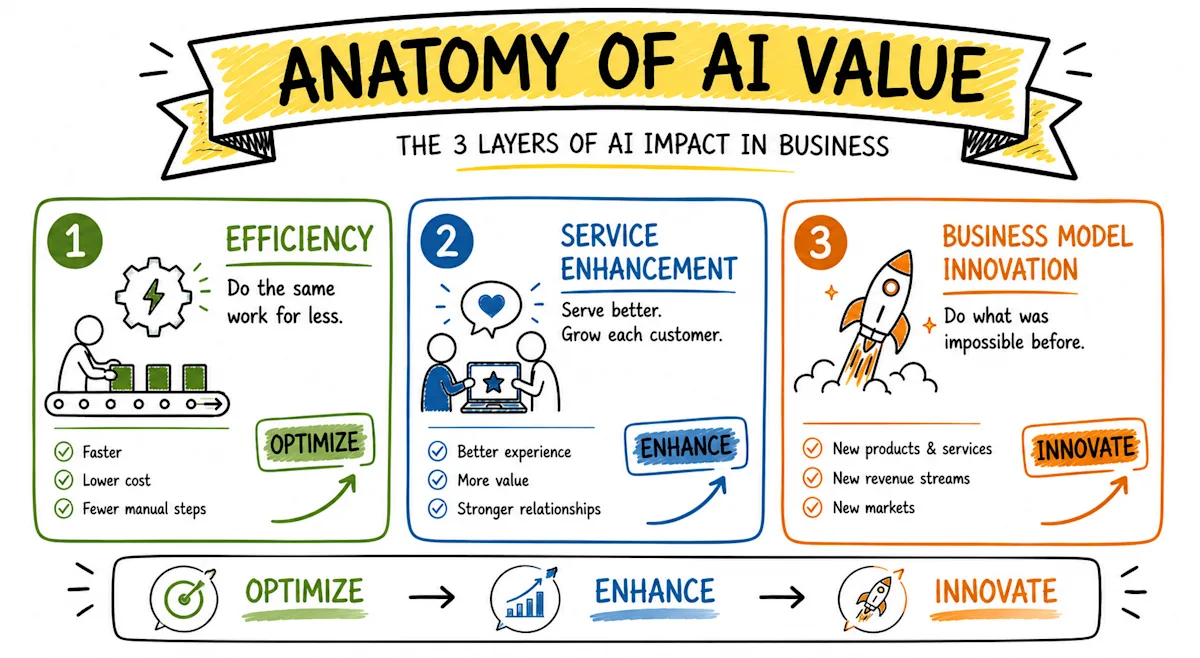
There are three layers of AI value, not one
That stopping point is not random. When I went deep on AI adoption in small and mid-sized companies for my doctoral research, the same structure kept surfacing. AI value does not arrive in one flavour. It arrives in three distinct layers, stacked on top of each other, and almost every company settles on the bottom one and never looks up.
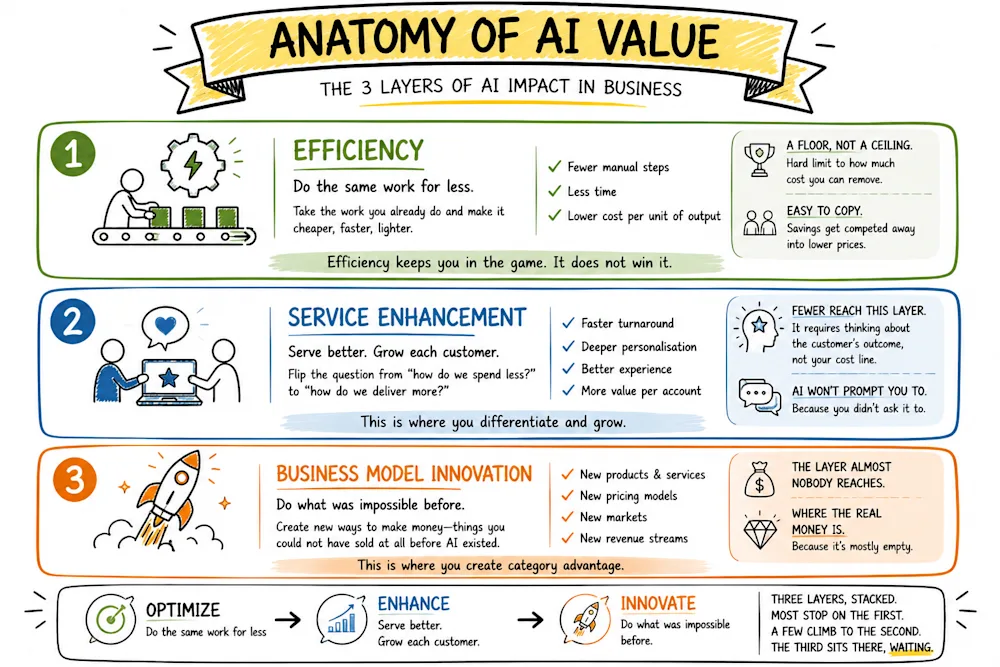
Layer one: efficiency - do the same work for less
Take the work you already do and make it cheaper, faster, lighter. Fewer manual steps, less time, lower cost per unit of output. This is where everyone starts, and it is worth doing. But two things are true about it that owners rarely notice. First, it is a floor, not a ceiling: there is a hard limit to how much cost you can remove, because you cannot go below zero. Second, it is the layer everyone else can copy. The moment the same tools reach your competitor down the street, the savings get competed away and handed to customers as lower prices. Efficiency keeps you in the game. It does not win it.
Layer two: service enhancement - serve better, grow each customer
Here the question flips from "how do we spend less?" to "how do we deliver more?" Instead of pocketing the capacity AI frees up, you reinvest it into the customer: faster turnaround, deeper personalisation, a better experience, more value per account. Fewer companies reach this layer, and the reason is telling. It asks you to think about the customer's outcome, not your own cost line. That is a different muscle, and AI will not prompt you to use it, because you did not ask it to.
Layer three: business model innovation - do what was impossible before
The third layer is a different animal. It is not a cheaper or better version of what you already sell. It is something you could not have sold at all before AI existed - a new way to make money that the technology itself has just put on the table. This is the layer almost nobody reaches. It is also where the real money is, precisely because it sits mostly empty.
Three layers, stacked. Most companies stop on the first. A few climb to the second. The third sits there, waiting.
What it costs to aim AI at the wrong layer
Knowing the three layers is one thing. Aiming AI at the right one is another, and getting it wrong is expensive. There is a famous version of this mistake. Kodak is usually remembered as a company that failed to see digital coming. It did see it - it invented the first digital camera. What it failed at was routing. It kept pointing its thinking at the efficiency layer, protecting the margins of its film business, when the situation demanded the third layer: a new business model built for a world that no longer needed film. It optimised the very thing it should have replaced. I made a version of this argument in a recent article for ICMCI (the International Council of Management Consulting Institutes, the global body for the consulting profession): the first job in any strategy is to read which kind of value the situation actually demands, not which kind is most comfortable to chase.
Kodak is the textbook case, but do not file this under "big-company problem." The same climb is open to ordinary SMEs right now, and some are already making it.
Take a B2B outreach agency, the kind that books qualified sales meetings for clients. On layer one it automated the grunt work - building and qualifying lead lists, drafting first messages - and pushed the same volume of outreach with a fraction of the hours. On layer two it reinvested that freed capacity back into clients, with more thorough work and a portal to communicate and deliver more around the core service. On layer three it did something new entirely: it launched AI-enhanced outreach as its own service, and eventually an autonomous AI agent that runs whole campaigns on its own - a product with its own pricing and market that could not have existed a few years ago.
And the pattern holds across very different businesses. A search marketing agency moved from speeding up keyword research (layer one), to far deeper research and sharper content (layer two), to a service that did not exist before: getting clients found and cited by AI answer engines, not just search engines (layer three). The agencies that refuse that move will be left behind. An online marketplace, whose oldest headache is that sellers post in rigid forms while buyers describe what they want in plain words, can put an AI agent in front of the buyer that asks a few natural questions and translates them into the criteria that match the right listings - not a faster version of the old marketplace, but a fundamentally better one that was impossible before AI could understand language this well.
So here is the real question. If the third layer is where the value is, and ordinary businesses can reach it, why does almost everyone still stop at the bottom?
Why everyone stops at cost-cutting
Here is the uncomfortable answer. It is not because you lack imagination. It is partly because of how the tool itself works.
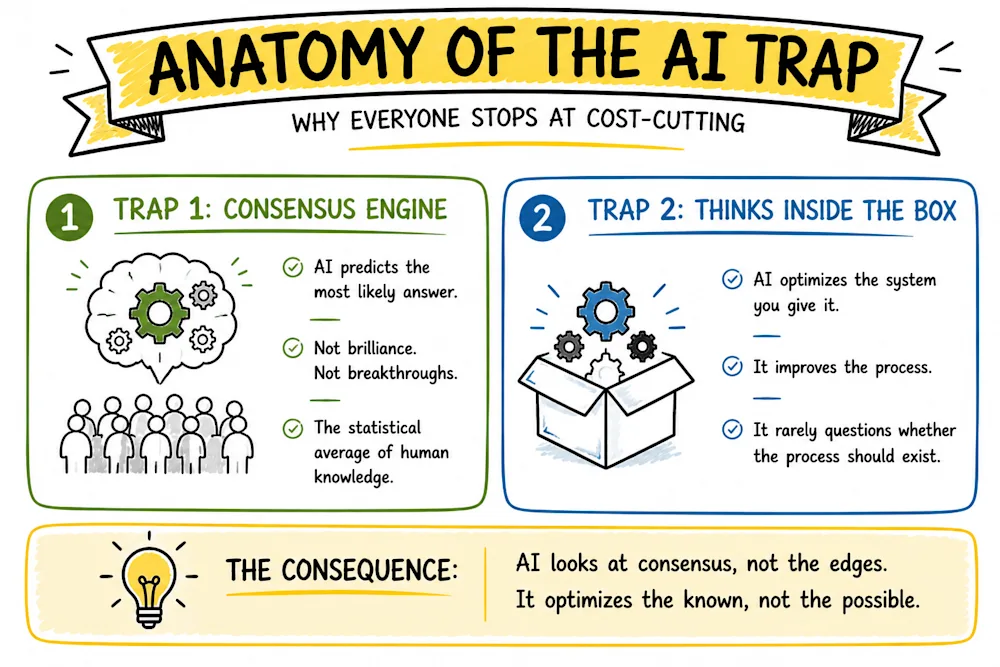
A large language model is not a genius in a box. It is a consensus engine. It is trained to predict the most likely next word across more or less everything humans have ever written, which means what it hands back to you is the statistical centre of human thought. The science-fiction writer Ted Chiang, in The New Yorker, called it "a blurry JPEG of the web." That is a good way to picture it. You are not getting brilliance. You are getting a compressed average.
And the average of all business advice ever written is overwhelmingly one message: do the same thing, cheaper. So when you ask AI how to improve your business, it answers from its own centre of gravity. It tells you to cut and automate, because that is what most of its training data is about.
There are two deeper problems hiding inside that.
One: it optimises inside the box you give it. Ask it to make your process cheaper and it will do a fine job making your process cheaper. It will not stop to ask whether the process should exist at all, or whether the whole model around it is about to be obsolete. It interpolates. It does not leap.
Two: it is a majority machine. Real innovation has always come from the minority who think differently - the people whose ideas looked wrong right up until they looked obvious. But a model built to predict the most likely answer is, by design, built to favour the majority and smooth the outlier away. A 2024 study in the journal Science Advances found exactly this: generative AI made individual writers more creative, yet made their stories, collectively, more similar to one another. Asking today's AI to invent your new category is a bit like asking the average of everyone who ever lived to design the next breakthrough. Averages do not invent. They blur.
The higher the value, the less the machine helps
Put those together and you get an inverse relationship almost nobody talks about.
Layer one, efficiency, is the densest part of the training data. Mountains of content exist on cutting cost and saving time, so AI is fluent, confident, and immediately useful there. Layer two, service, is thinner but still well covered. Layer three, a genuinely new business model, is the sparsest region of all - category-creating moves are rare by definition, so they are under-written, under-represented, and under-suggested.
So the further up the value ladder you climb, the less the average-machine can help you, and the more it becomes a human job. Everyone crowds the bottom rung because that is where the AI is loudest. The top rung is quiet. That quiet is the opportunity.
A note to self, and the real point
By now you might be thinking what I sometimes think, half-joking: maybe the answer is to build a different AI - one trained only on the smartest, most original people who ever lived. Feed it nothing but the outliers and let it think out of the box on demand. Note to self: register the domain.
Except it would not work, and the reason it would not work is the whole point. You cannot bottle a visionary from text. Half of what makes an outlier an outlier is reading a situation that has never existed before, which is exactly the thing that was never written down. So until that magic AI arrives - and it will not - the out-of-the-box thinker in the loop has to be you.
That is the practical takeaway, and it is good news, not bad. Use AI relentlessly on layers one and two, where the data is dense and the machine is strong. Let it cut your costs and sharpen your service. But for layer three - the new business model, the move your industry has not made yet - keep yourself in the driver's seat and use AI as a sparring partner you deliberately drag off the average. Push it past its comfortable centre. Make it argue with you.
The companies that win the next decade will not be the ones that automated fastest. They will be the ones that used AI to climb to a layer their competitors never even looked at.
So before your next AI project, ask the bigger question. Not "what can we cut?" but "what could we now do that was impossible before?"
Which layer is your business actually working on?
Want help finding your layer-three move?
If you want help finding your layer-three move - not just automating what you already do - that is the conversation we have in a Business Pulse AI session. And if you are still on layer one and want the practical how, here is the roadmap for putting AI to work across your business: map, automate, AI-sate, humanize.