AI-isation for SMEs: A Practical Framework for Founders
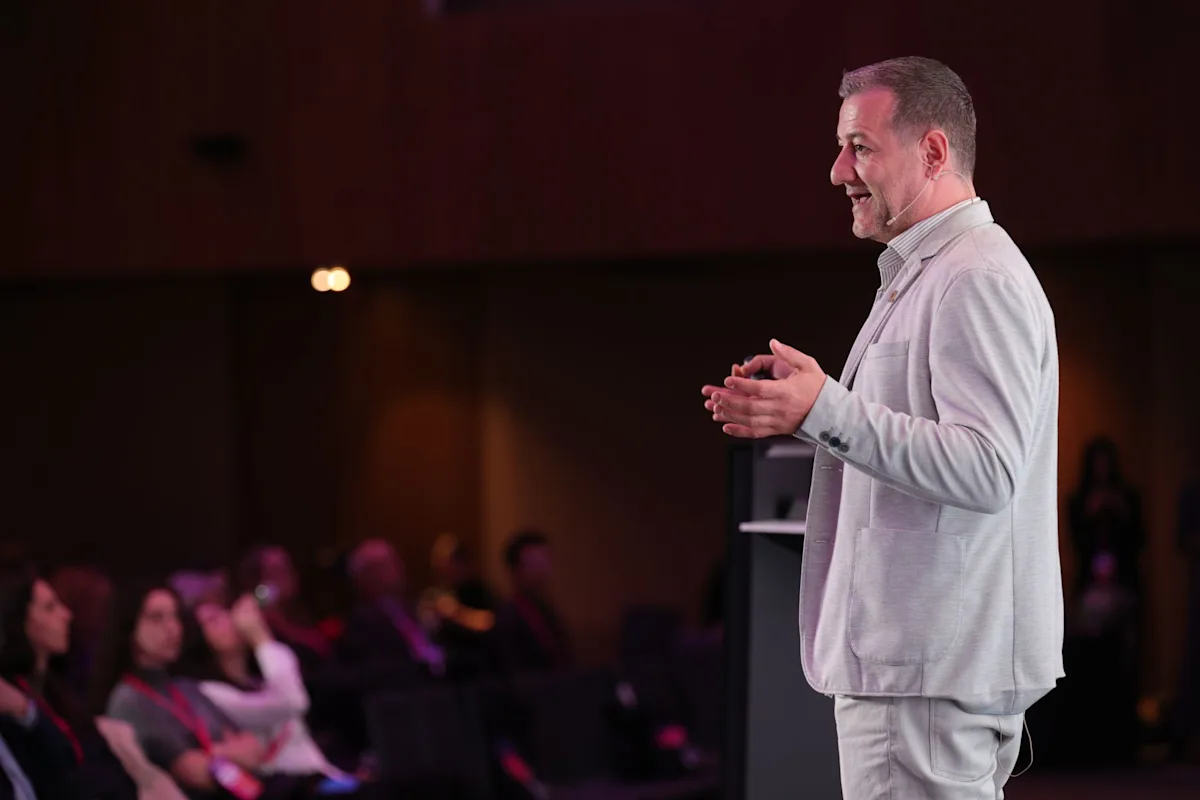
For years, AI belonged to companies with big budgets and data teams. That has flipped. This is the framework I shared at WITCON 2025: how an SME founder turns AI from hype into a department-by-department advantage, and why small companies are now the ones positioned to win.
For most of the last decade, "use AI" was advice for companies that could afford a data team, a six-figure software budget, and a year of integration work. If you ran a 15-person company, it was not for you. You watched the corporates do it and got on with your day.
That era is over. Ten years ago this topic would have been irrelevant for an SME. AI was expensive: you needed data centres, data scientists, teams of engineers. Then ChatGPT and a wave of no-code tools arrived, and as I put it on stage, AI came down to street level. Accessible. Affordable. Practical.
I made this the core of my talk at WITCON 2025 - Women in Tech Macedonia: AI-isation of SMEs, giving small and medium businesses a competitive advantage through AI and automation. It is also the question behind my doctoral research. I am doing a DBA at University American College Skopje on AI and automation adoption in service-based SMEs, building a diagnostic and a staged roadmap for exactly this problem. So what follows is field-tested across 600+ BizzBee engagements and grounded in formal research.
The advantage has flipped
For the first time in history, an SME can compete with a corporation on technology, not because it has more resources, but because the playing field finally leveled. The capability that used to require a department now requires a login.
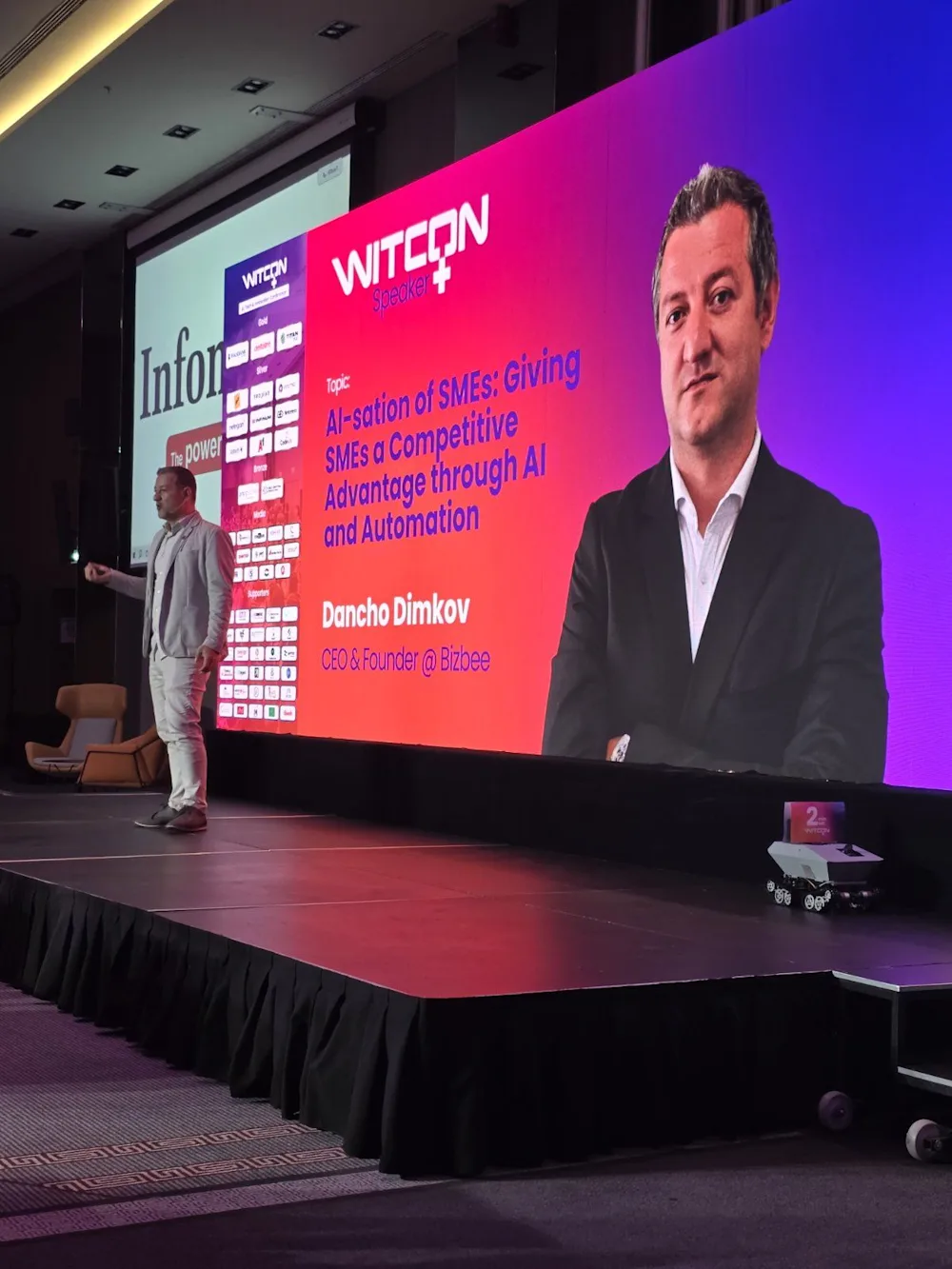
Here is the part that should make every founder sit up: this favours you, not the giants. As I said at WITCON, "small companies can move faster, adopt AI quicker, and outcompete giants." The corporate advantage in AI was money. Money no longer buys the edge. Speed does.
The real problem isn't access, it's guidance
Even though AI is now within reach, most SMEs still do not know how to start. And the reason is not the tools. It is the map.
Corporations hire McKinsey, Deloitte and Accenture. They have multi-year digital-transformation frameworks and millions to spend. SMEs do not. So a small business has the access to AI but not the guidance to use it.
This is not just what I have seen across hundreds of engagements. It is the gap at the centre of my doctoral research: the established digital-transformation models, the ones every consultant quotes, were built for large enterprises. None were designed for a service SME adopting AI. So when a 20-person firm reaches for a corporate playbook, it is reading the wrong map. An SME is not a small corporation, and it needs a framework built for its reality.
Why AI actually works better in an SME
It sounds backwards, but it is true. Look honestly at what an SME lacks, and what it has instead.
- What you lack: budget, people, systems, IT resources, time.
- What you have: agility, speed, decision power, and flexibility, because the person who decides is the person who pays for it and benefits from it. You.
This is exactly why AI works better in SMEs than in big companies. The things that make corporates slow, their scale, process and approval layers, are precisely what makes AI adoption painful for them. You do not carry that weight. Your size is the superpower.
The roadmap: map, automate, AI, humanize
A framework is only useful if you can act on it. The sequence I use, and the backbone of the roadmap in my research, has four stages. Each depends on the one before it. Skip a stage and the next collapses.
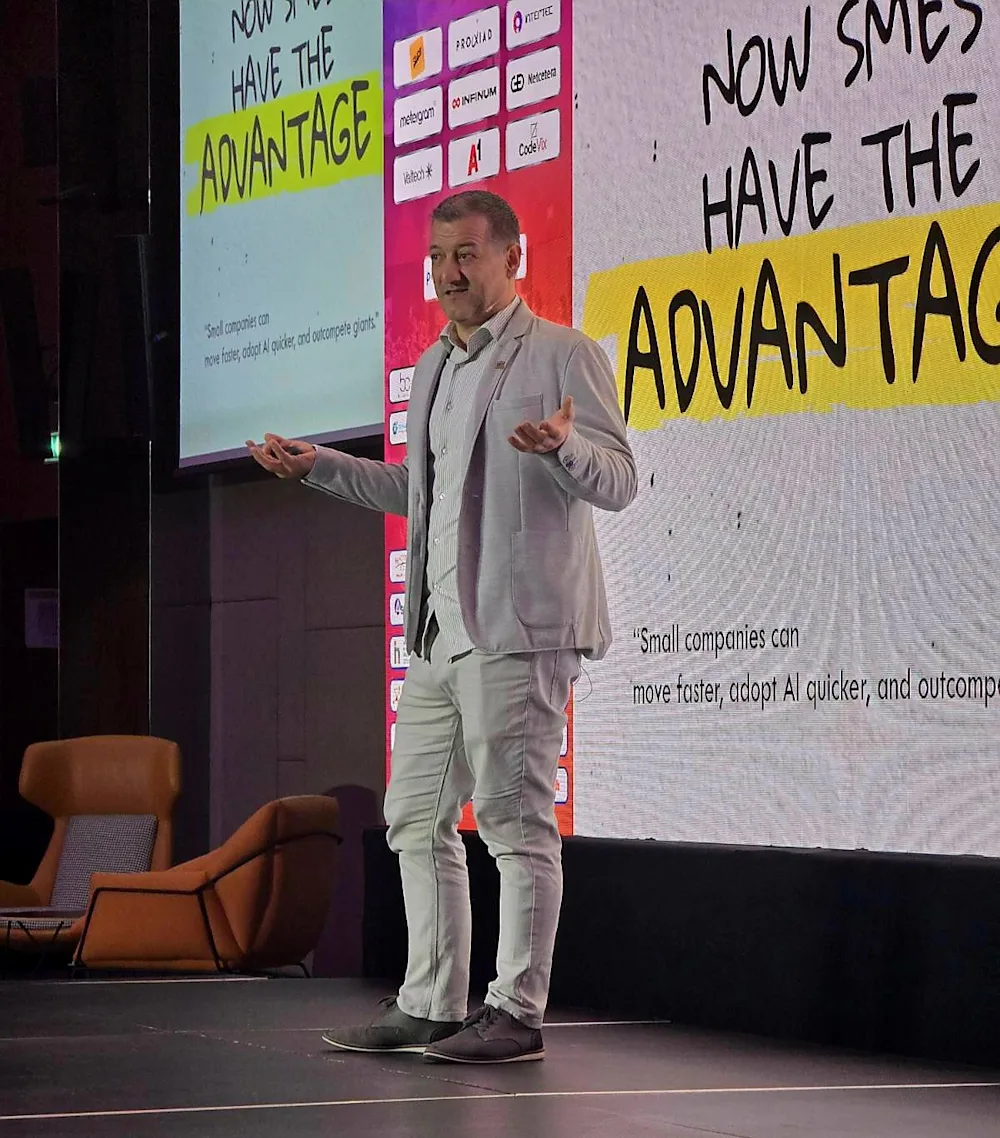
1. Map. You can't automate or AI-sate what you can't see. Before anything else, make the work visible: how you actually work, who does what, where the bottlenecks are. AI amplifies whatever it touches, so point it at a clear process, not a hidden one. If you have never done this, start by documenting your first 20 processes.
2. Automate. Once you can see a process, remove the friction first, before adding any intelligence. The repetitive, rules-based, data-driven steps are the easy wins, and automation often removes the tasks humans never liked doing anyway.
3. AI. Now add intelligence on top, for anything that needs text, analysis, content, decisions or predictions. This is where modern AI shines, and where a mapped, automated process becomes genuinely smart.
4. Humanize. Not everything should be automated. With the busywork gone, you give your people back the work only humans do well: leadership, strategy, relationships. Humans do what humans do best, AI does the rest.
In one line: automate the predictable, AI-sate the scalable, humanize the strategic.
AI-sation, department by department
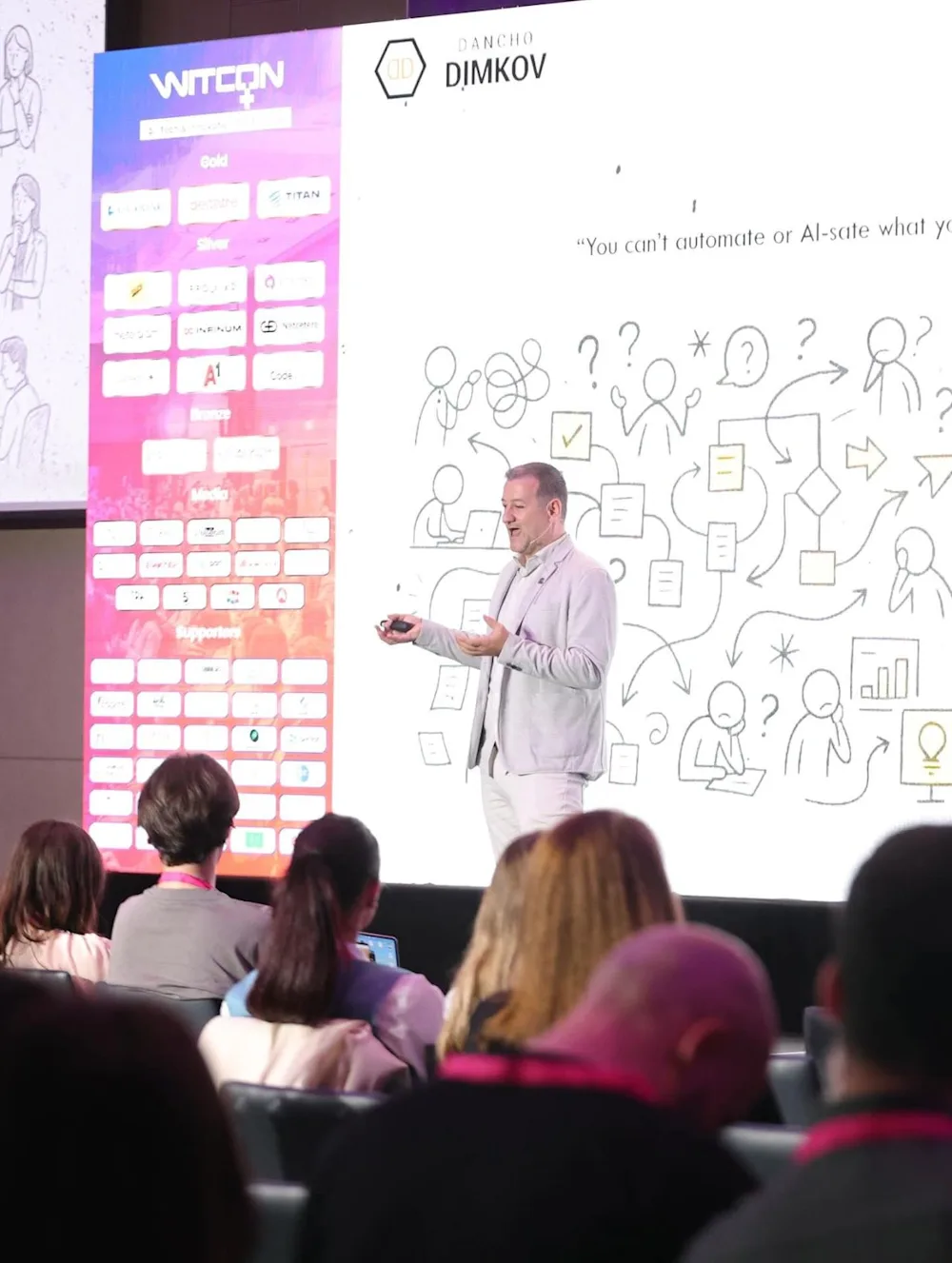
You do not "do AI" as one big project. You do it one function at a time. Here is what it looks like in practice.
Sales. Picture a small sales team: one rep writes emails by hand, another updates the CRM at midnight, a third spends half the day hunting for leads. With AI-sation, AI writes the personalised emails, automation finds and qualifies the leads, AI drafts the proposals, and the CRM updates itself. Your team only does what matters: real conversations and closing.
Customer support. Two hundred messages a day stops being a crisis. Around 70% of routine questions get answered instantly, and your people handle the complex, emotional ones that actually need a human.
Marketing. You do not need a team of ten. One person creates content for every channel, ads are generated, SEO is analysed, and campaigns run on their own.
Operations and admin. Scheduling, invoicing, inventory, reports. The bottlenecks clear and your team gets its time back.
Finance. AI turns spreadsheets into dashboards, explains your numbers in plain English, and forecasts trends, so decisions stop being guesswork.
The four layers of AI
Not all "using AI" is the same. In my PhD research I describe four layers, and most SMEs are still on the first.
Layer 1 - AI as a productivity tool. The starting point: your team uses AI in daily work and becomes faster, smarter, more capable. Valuable, but it is still a human doing the job with a better assistant.
Layer 2 - AI as a digital employee. The real shift. You stop treating AI as a tool someone picks up and start treating it like a team member, with a role, responsibilities, a way to collaborate with your people, and performance you check. It works nights and weekends and never asks for a raise.
Layer 3 - AI as a leadership tool. Leaders use AI to think better, decide better, and plan better, pulling the numbers together and pressure-testing decisions before they are made.
Layer 4 - AI as a leader. The frontier. It has already begun: in 2022 NetDragon appointed an AI, "Tang Yu," as rotating CEO of one of its subsidiaries, and back in 2017 Jack Ma predicted that "in 30 years, a robot will likely be on the cover of Time Magazine as the best CEO." You do not need an AI CEO. But AI guiding systems and decisions, with humans steering direction, is no longer science fiction.
Leadership is the glue. Without it, AI-sation collapses. Leading an SME in an AI world takes a strategic mindset, not a technical one.
The SME opportunity
For the first time ever, SMEs have a genuine window. The tools are cheap and in your hands, your size is an advantage rather than a handicap, and the only thing standing between you and a real edge is a framework and the discipline to start with one win instead of boiling the ocean.
AI tends to pay off in one of three ways for an SME: doing the same work with less effort, serving your customers better, or opening a new way to make money. Pick the one that matters most to you right now, and start there.
What to do next:
- Pick one workflow where the pain is loudest.
- Map it - write down how it actually works today.
- Automate the friction, then assign the rest to AI as a digital employee with a clear job.
- Measure it for a month, prove the ROI, then move to the next workflow.
You do not need millions. You do not need a big team. You do not need to be technical. You need curiosity, courage, a willingness to change, and the first step. This is exactly the work we do inside our AI engagements: finding where AI gives your business the fastest edge, and building the framework around it so it sticks. The future doesn't belong to the biggest. It belongs to the fastest.