Is Your Business Data Ready for AI? 5 Things to Fix Before You Pay Anyone
AI tools and consultants both run on your company's data, and in most small companies that data sits in five places nobody has connected. Here are five things an owner can fix in a week, before paying anyone to build AI or diagnose the business.
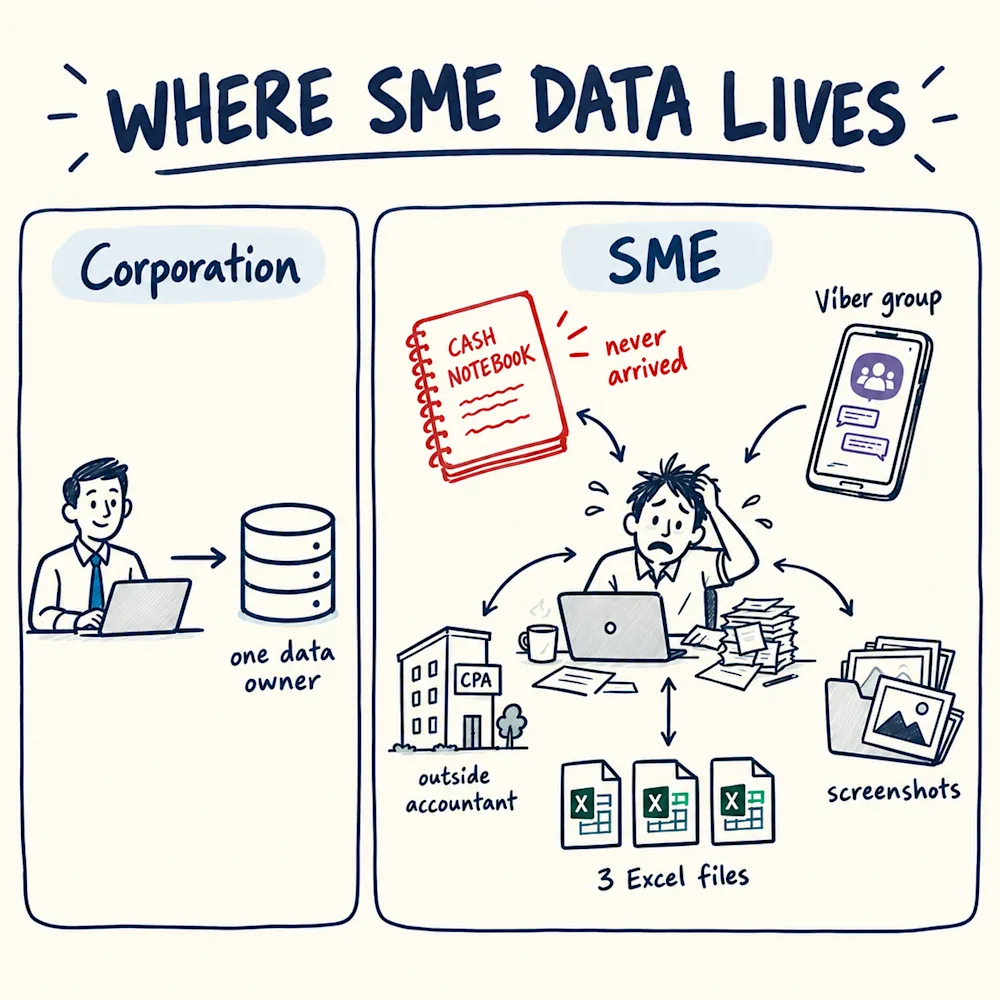
Ask your team for one number this week: how much did each client bring in last year, month by month? Then watch what happens. Someone opens the accounting program. Someone else has a better Excel. The cash sales are in a notebook. Half the invoices are PDFs in an email folder. Two days later you get an answer, and nobody is sure it is right.
That is normal. You built a company, not a data department. A corporation pays people whose whole job is to keep the numbers in one place and in one shape. In a company of ten or thirty people, the owner is busy keeping the business alive, and a tidy spreadsheet does not pay salaries.
It becomes a problem the moment you want AI. Every AI tool, and every consultant you hire to look at the business, runs on that same data. When I tell other AI consultants "AI is easy, if the data is structured", they smile, because they have all been there. In my last post I wrote about how much of your company AI should run. This one is the step before it.
What we find when we ask for the data
Here is what owners sent us in our diagnostic work this year. A restaurant's invoices came as 446 files, which turned out to be 178 invoices once the Word and PDF copies of the same invoice were matched. Payroll came as a screenshot of the accountant's portal. The handwritten cash notebook was asked for in May and still had not arrived in September. An agency told us, honestly, that it does not measure sales by channel at all.
None of these owners were careless. The data existed. It just lived in five places, in five shapes, and bringing it together was nobody's job.
The good news is that most of it an owner can fix without a data scientist and without buying anything.
1. Name one person and one place
Pick one person who knows where things are, and one shared folder. Then make a simple list, one line per document: what it is, who keeps it, and how often it is updated. The accountant's reports, the bank exports, the sales spreadsheet, the delivery platform exports, the cash notebook.
The list matters more than the folder. The day a consultant or an AI tool starts, it is the first thing they need.
2. Send exports, not screenshots
A screenshot of a report is a picture. Nobody can add it up, sort it or check it. Most accounting programs, banks and delivery platforms can export to Excel or CSV. Ask your accountant for the export once, and then for the same export every month.
3. One row for one thing that happened
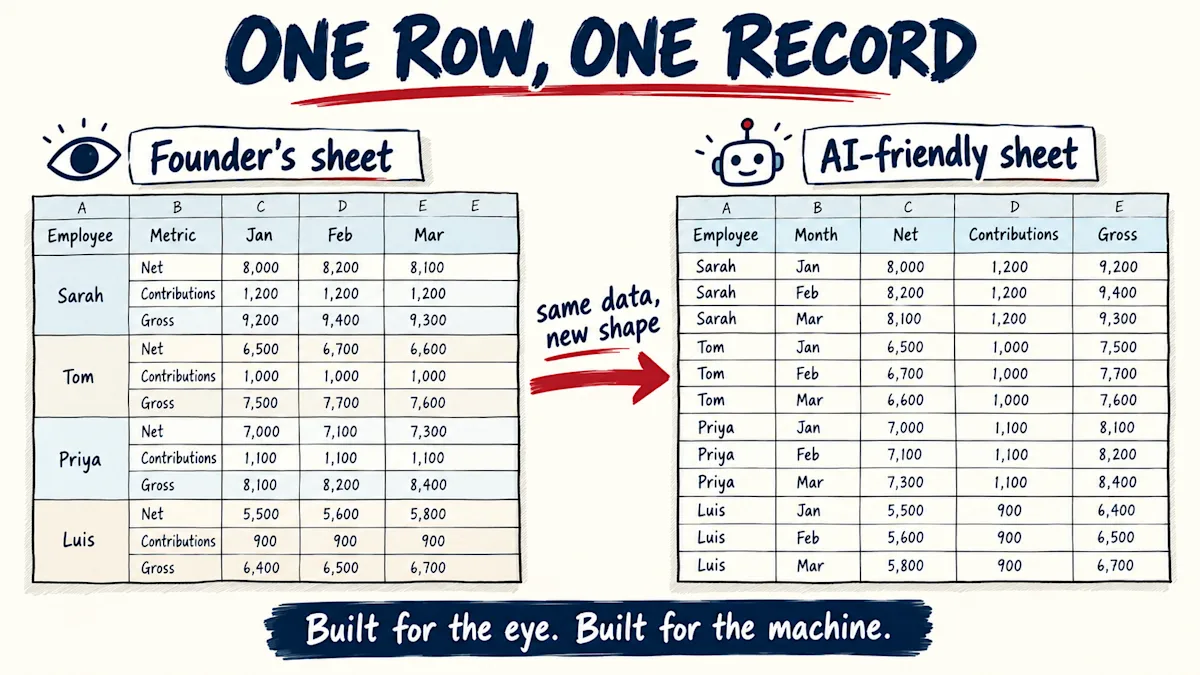
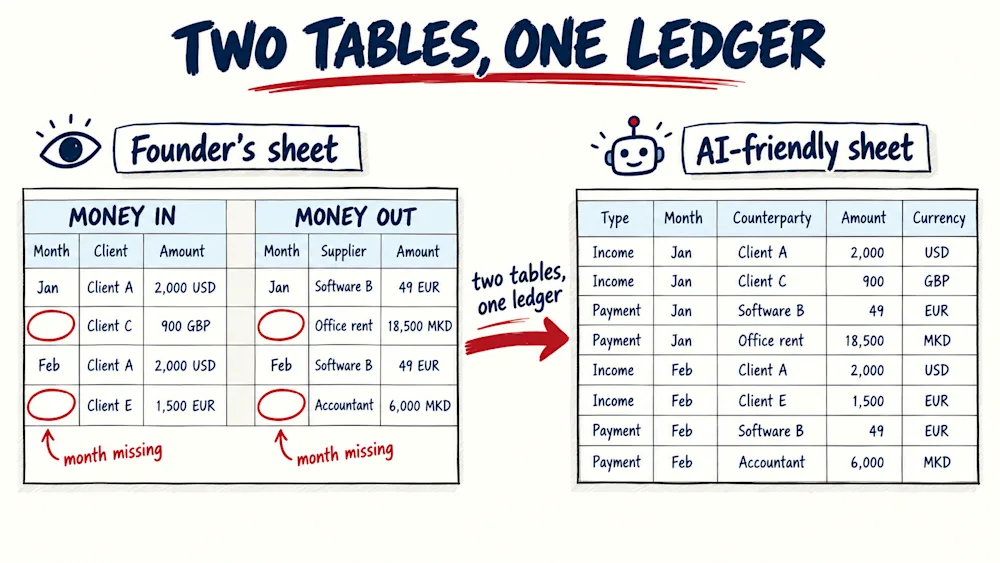
Most owner spreadsheets are built to be read with the eye: months running across the top, a block of rows under every employee, money in and money out side by side on one sheet. A person reads that fine. A machine does not.
The rule is simple: one row is one invoice, one payment, or one salary for one month. The month goes in its own column, on every row, not across the top.
4. Write the same thing the same way
In one agency workbook we saw January written four ways: ЈАНУАРИ, January, Јануари and Jan. To you, obviously the same month. To any tool that adds up by month, four different months, and a wrong total without a warning. Pick one way to write months, clients and categories, and keep it every year.
Keep blanks and zeros apart. An empty cell means nobody knows. A zero means nothing happened. A restaurant's till system showed zero waste on all 1,031 trading days. Nothing was recorded, and that is not the same as nothing wasted.
5. Keep the records, not only the totals
Totals are for reading. Records are what can be checked. If your only file is a summary someone typed in, nobody can tell whether it is right. Keep the invoices, payments and exports underneath, and let the totals be calculated from them.
When a window manufacturer's 16 separate monthly cost files were put into one table, it showed about 189K MKD of loan payments that their own file had left out.
What this changes
Once the data sits in one place and in one shape, the slow part of any AI project or diagnostic gets much shorter. In our own diagnostic work, the data step used to take weeks. With the data organised and AI doing the restructuring, it runs in hours, and the time goes into what you actually pay for: understanding what the numbers say about your business.
Collecting the data was never the valuable part. It is just the part that has to happen first.
Where to start this week
- Pick the one person who knows where things are.
- Make the list of documents: what it is, who keeps it, how often it changes.
- Ask for exports from your accountant and your bank instead of screenshots.
- Check your main spreadsheet against the rules above: one row per thing that happened, one spelling, blanks not zeros, records under the totals.
- Only then talk to an AI vendor or a consultant.
If you want to see where your business stands first, the free business health check takes about four minutes and scores you across clarity, structure, growth and AI.