Export Strategy for SMEs: What the Numbers Don't Tell You
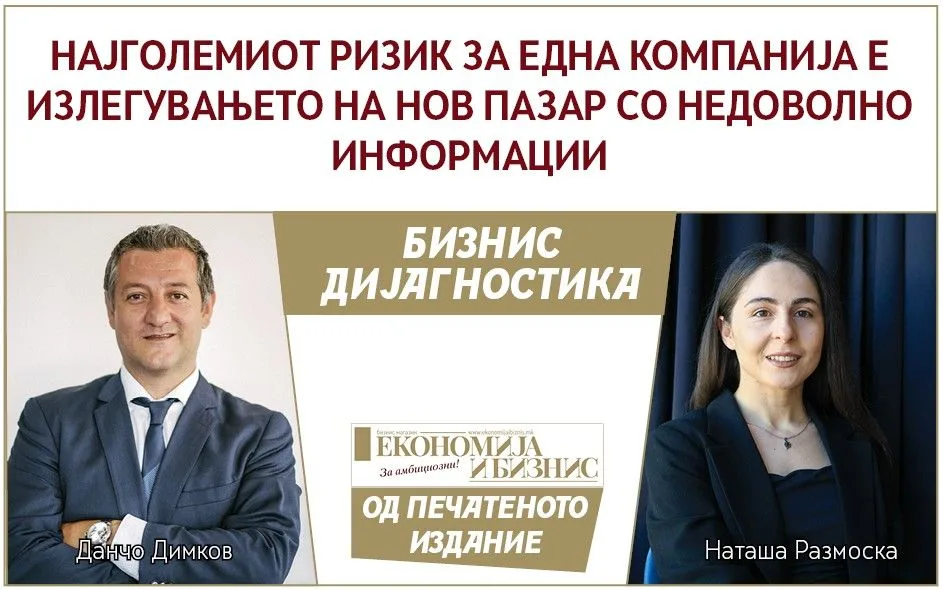
A spreadsheet can tell you what exporting might earn - not whether you're ready to earn it. In Ekonomija i Biznis, Natasha Razmoska and I argued that the biggest risk in going abroad isn't money, it's entering a new market with insufficient information. Here's what the numbers leave out, and how to close the gap before you export.
Most export decisions start with a spreadsheet. Projected volumes, target price, margin, the cost of getting goods across a border - and if the bottom line looks good, the company commits. The problem is that the numbers describe the prize. They say almost nothing about whether you're ready to win it.
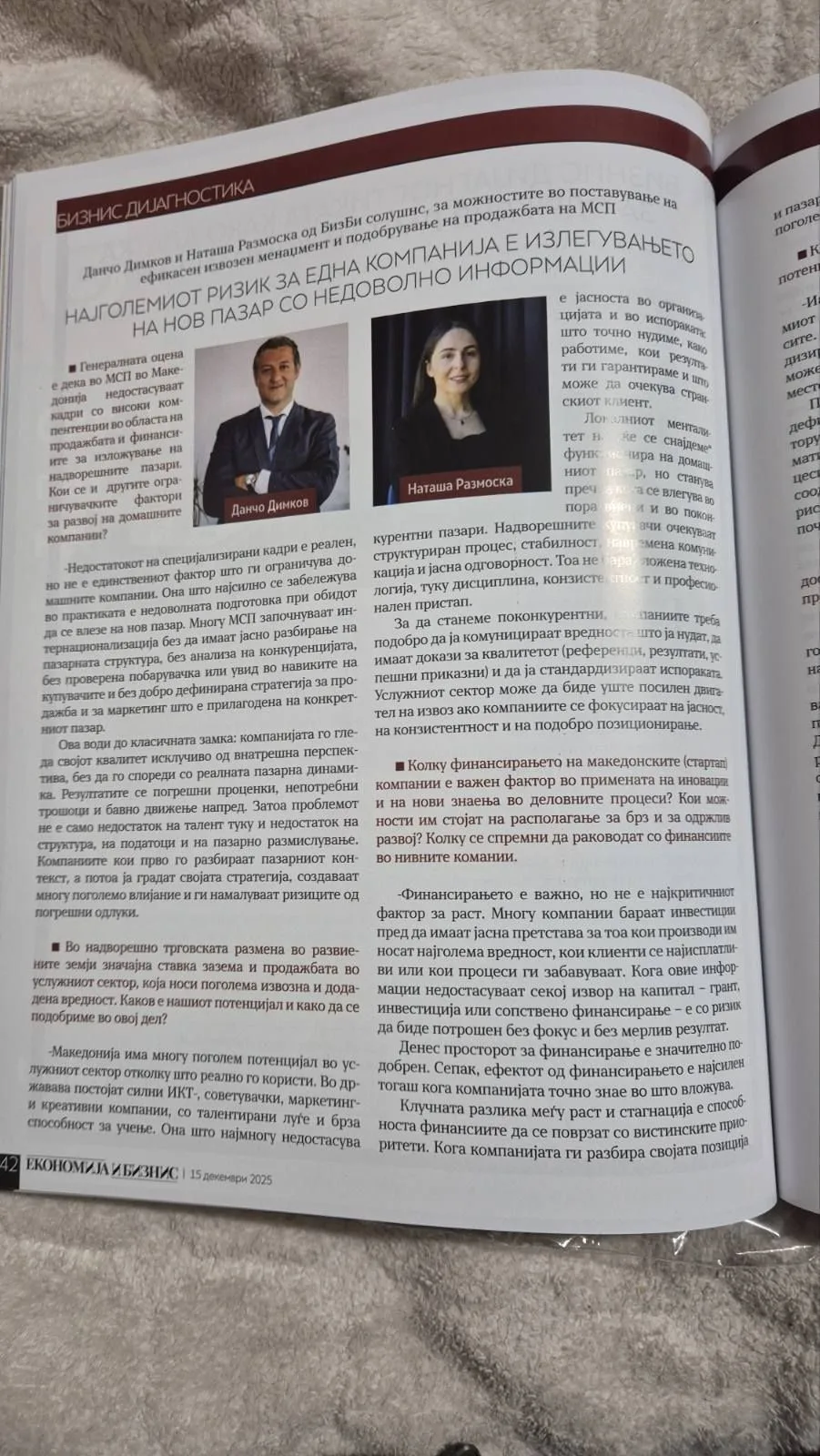
In Ekonomija i Biznis magazine, Natasha Razmoska and I were asked about export management and improving sales for SMEs. The line that summed it up: "the biggest risk for a company is entering a new market with insufficient information." Not insufficient capital - insufficient information. Here's what the numbers don't tell you, and what to do about each.
The real risk isn't financial - it's informational
When SMEs start to internationalise, the optimism is usually high and the preparation usually thin. Companies go abroad without a clear grasp of the market structure, without analysing the competition, without verified demand or insight into how buyers actually behave, and without a sales and marketing strategy adapted to that specific market.
That leads to a classic trap: you judge your own quality purely from the inside, never measured against the real dynamics of the target market. The result is wrong estimates, unnecessary costs, and slow progress. So the gap isn't only a shortage of talented salespeople - it's a shortage of structure, data and market thinking. The companies that understand the market context first, and only then build their strategy, create far more impact and carry far less risk.
What the numbers don't tell you (1): whether you actually understand the market
A cost calculation assumes you know your buyer. Often you don't - not really. Do you know the market structure, the competitors already there, whether demand is verified rather than assumed, how customers in that market actually decide? None of that shows up in a margin calculation, and all of it decides whether the margin is real.
What the numbers don't tell you (2): whether your delivery can be trusted
Macedonia has far more potential in services exports than it actually uses - strong ICT, consulting, marketing and creative firms, talented people, fast to learn. What's missing most isn't capability; it's clarity: what exactly we offer, how we work, what results we guarantee, and what a foreign client can expect.
The local "we'll figure it out as we go" mentality works at home. Abroad, in more developed and competitive markets, it becomes a liability. Foreign buyers expect a structured process, stability, timely communication and clear accountability. That doesn't take complex technology - it takes discipline, consistency and a professional approach. To compete, you have to communicate your value clearly, show proof of quality (references, results, success stories), and standardise your delivery. A spreadsheet won't flag the deal you lose because your follow-up was late.
Money follows clarity - not the other way around
Here's the counter-intuitive part: financing is important, but it isn't the most critical factor for growth. Plenty of companies chase investment before they can say which products bring the most value, which customers are the most profitable, or which processes are slowing them down. When that information is missing, every source of capital - a grant, an investor, your own money - risks being spent without focus and without a measurable result.
Financing is far more available today than it used to be. But its effect is strongest when the company knows exactly what it's investing in. The real difference between growth and stagnation is the ability to connect money to the right priorities. We unpacked the home-market version of this in The Financial Realities Most SME Founders Won't Admit.
And tools follow processes
The same logic applies to digitalisation. The biggest challenge isn't the technology - it's the processes underneath it. Bolt a tool onto unmapped, unstandardised work and it becomes another complication instead of a real efficiency gain. Define how the company actually works first - what repeats, where the bottlenecks are, what to automate, what needs a human - and the right technology becomes obvious. Why productivity advice fails SMEs is the same story.
How a business diagnostic closes the gap
This is exactly where a business diagnostic earns its place before you export. It lets you systematically check the critical elements that decide success: Does the company understand customer needs? Is the offer competitive and clearly positioned? Are sales and marketing processes in order and repeatable? Can procurement, logistics and production handle increased demand? Is the organisation stable enough to support growth?
In other words, it lowers the risk of bad investments and unrealistic expectations. It shows the whole picture - from internal capacity to real competitiveness - so you can build a realistic, achievable export strategy. In practice that means entering the foreign market prepared: a clear offer, an aligned process team, a solid cost calculation, things you can measure and track, and a sales plan you can keep improving. Without that foundation, export is more luck than strategy. With it, it becomes a controlled, predictable and sustainable initiative. It's the same structured diagnostic approach we apply to any growth decision.
What actually happens after the diagnostic
A diagnostic doesn't solve your problems - it makes them visible, concrete and clear. It's a roadmap. The real work starts the moment it's done.
The first step is setting priorities. The analysis usually reveals a string of interconnected weaknesses, and you can't fix them all at once - so the owner and the management team choose the few with the biggest impact on growth, stability and export capacity. That creates a focus that was missing before. Then the action plan goes live: named owners, KPIs, a timeline, a clear tracking system. That's when the real transformation begins - communication gets clearer, processes get standardised, and decisions start being made on facts instead of assumptions.
The biggest change, though, is cultural. When a team finally sees structure, transparency and mapped steps, trust and accountability grow. And that's what makes a company not just better run, but genuinely more attractive to foreign markets. The diagnostic is the starting point. Growth is the journey that comes after.
What to do next
Before you build the export spreadsheet, answer the questions the spreadsheet can't: Do you truly understand the target market? Can a foreign buyer rely on how you deliver? Are your processes ready for more volume? If any answer is "not sure," that's where the real risk lives - not in the financial model.
A Business Pulse diagnostic checks exactly these elements and turns "we think we're ready to export" into a clear, prioritised plan - so your next market is a controlled decision, not an expensive bet.