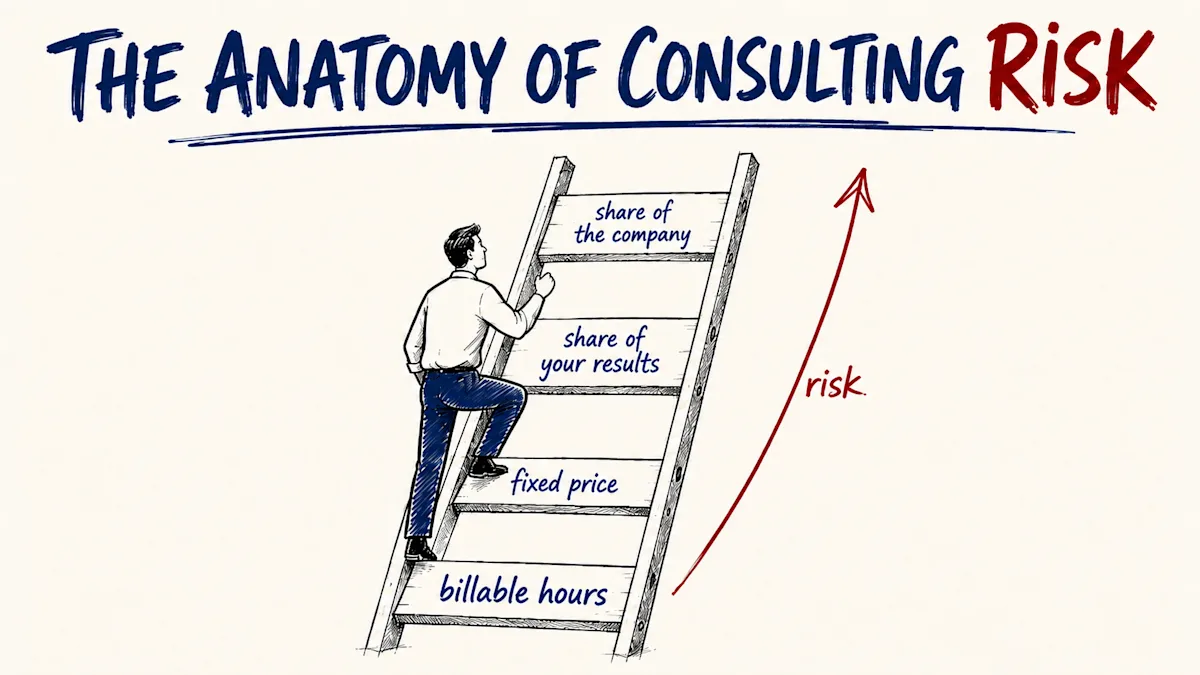
Who carries the risk when you hire a consultant?
You hire a consultant because you have a problem to solve, and the proposal that arrives almost always says the same thing: a rate per hour. You did not choose that, and it is the one arrangement where the consultant carries no risk at all. There are four ways a consultant can be paid, and for you they run from maximum risk down to almost none, each step of safety with its price. Here is how to read your next proposal by the only question that matters: who carries the risk.
You do not wake up one morning wanting a consultant. You wake up with a problem that will not move, or an opportunity you do not want to miss, and you need someone who has seen it before to show you the way.
So you ask around, you find someone good, and the proposal arrives. And there it is, the line every owner knows: a rate, per hour.
You did not choose that. If anyone had asked you, you would have chosen the obvious thing: pay for the result. Problem solved, opportunity captured, then we talk about money. Nobody asked. Hourly is simply what most of the profession puts in front of you, and it is worth understanding why: it is the arrangement where the consultant carries no risk at all.
Charlie Munger said it in six words: show me the incentive, and I will show you the outcome. Whatever the contract rewards is what your money buys. So let me show you how to read a consulting fee the way you would read any other deal: by asking who carries the risk. There are four ways a consultant can be paid. For you, they run from maximum risk down to almost none, and each step of safety has its price.
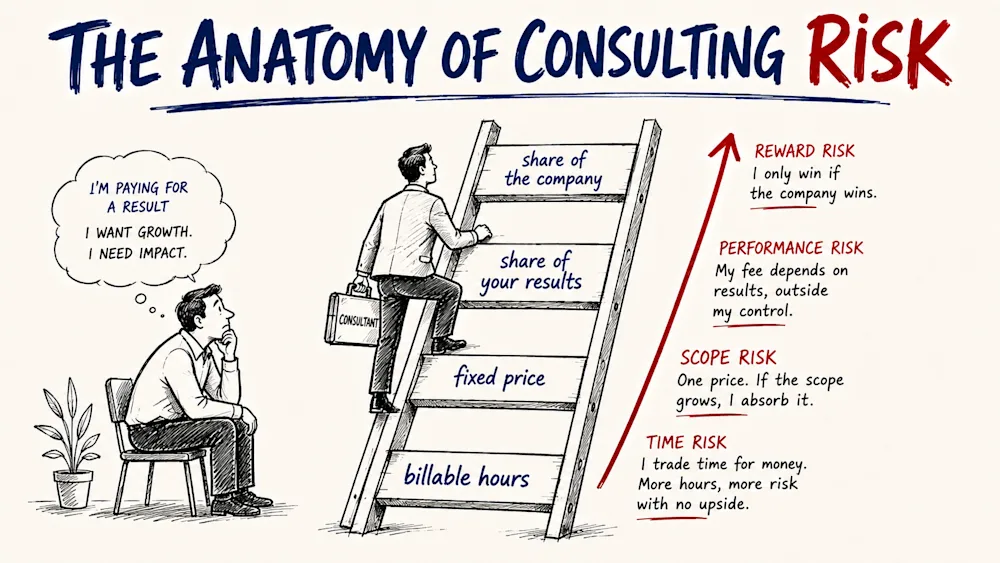
The hour: your risk at its maximum
Pay by the hour and you carry everything. If the work goes slowly, you pay more. If the scope grows, you pay more. If the advice does not work, you have already paid anyway. The consultant is paid the same whether your business wins or loses. Delay risk, scope risk, result risk: all three sit on your side of the table, and every one of them arrives on your invoice.
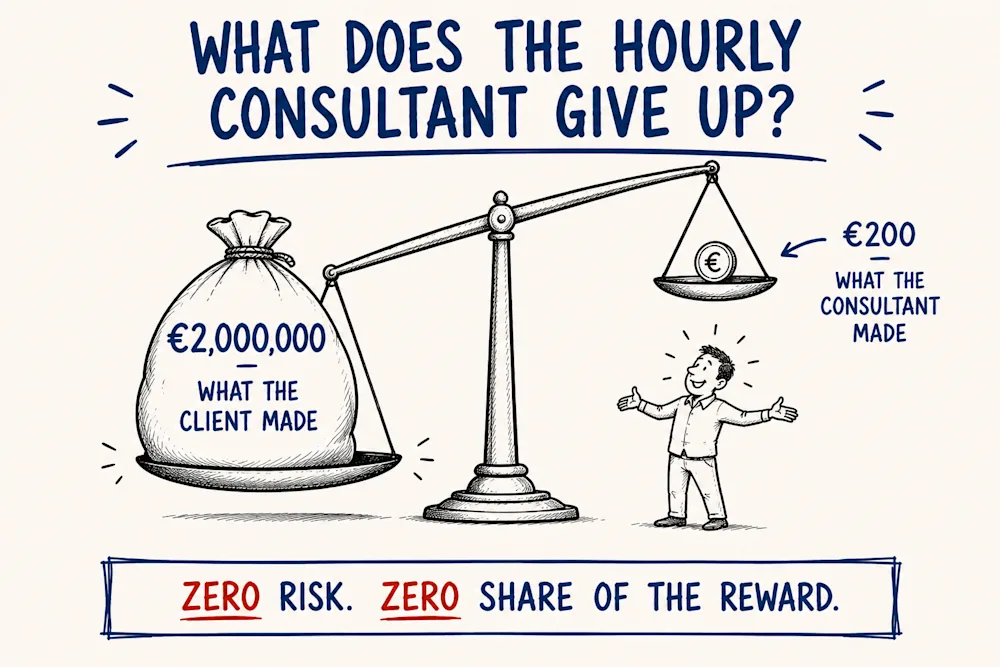
To be fair, there is one purchase where hourly is honest: when the hour itself is what you are buying. A call with someone who has seen your problem fifty times, one conversation, one way forward. I sell advice exactly that way, coaching at €200 an hour: one session, one problem, no programme, no lock-in. For that, hourly is the right model, because the conversation is the deliverable and it ends when the call ends.
The warning sign is hourly on a project. If the proposal contains a deliverable, a plan, a report, a system, and the price is per hour, read it again: you have just agreed to pay more the slower it goes.
The fixed price: the first risk crosses the table
For any defined piece of work, ask for three things: a fixed price, a named list of deliverables, and an end date.
Watch what that one change does. If the work takes longer than planned, that is now the consultant's problem, not your invoice. Their own margin depends on finishing well and fast, so speed becomes their interest, not a favour to you. The delay and scope risks just crossed the table. You still carry the result risk, but you know exactly what this attempt at the result will cost you, and when it ends.
I price my own business diagnostics exactly this way: a fixed number of days, a documented method, a verdict at the end, a price agreed before we start. Earlier this year we ran a four-week engagement for a kids-education centre preparing to franchise: fixed fee, four weeks, a named list of deliverables. We delivered in four weeks, and not because the client pushed us. The fee model made speed our own interest.
A share of the result: you pay mostly when it works
The third model belongs to execution work, when a consultant is not just advising you but working alongside you: on your pipeline, with your people, until the system produces.
Remember the kids-education centre from the last section? That four-week engagement was phase one, and it ended the way fixed-scope work should end: deliverables handed over, on time. But at that point the client did not need more documents. They needed franchise partners signed. So for phase two we changed the deal itself: a smaller fixed base, plus a percentage of every partnership closed. I wrote one line into that proposal: our role is no longer advisory, it is operational. From that moment, documents stopped mattering to me. Signed partners were the only thing that paid.
Look at your side of that deal. Your risk dropped again: most of the money leaves your account only when the result actually arrives. The price of that safety is the percentage. When it works, you pay more than a flat fee would have cost, and you pay it gladly, out of money that exists because it worked.
This model also hands you the single most useful question you can ask at proposal stage: "Would you tie part of your fee to the result?" You will learn more from the answer than from any reference call. A consultant who says yes believes the result will come and is willing to wait for their money until it does. A consultant who hesitates may still be good at the work, but now you know what the proposal never says out loud: who they expect to carry the risk. You.
Equity: your risk at its minimum, and the biggest price of all
There is a fourth model you will rarely meet. Sometimes a consultant offers to be paid in ownership: their work converts into a share of your company. I have done it twice, with companies I believe in.
For the owner, this is the bottom of the risk ladder. You might pay nothing today. If the consultant's work does not make the company more valuable, their time was free. Almost all the risk now sits on their side.
But notice the price of that safety, because it is the biggest one on this page: a piece of your company, forever. If things go well, that share will be worth far more than any fee you could have paid. That is exactly why the consultant wants it, and it is the strongest vote of confidence anyone can cast in your business: they trust your company more than their own invoice.
That is the whole ladder, and here is the pattern it draws. Risk never disappears from a consulting deal. It only moves across the table, and every step it moves away from you, you pay for it with a bigger share of the win. Hourly is cheap-looking and loads everything on you. Equity protects you today and costs you the most upside. The right question is never "what is the rate". It is "how much risk do I want to keep, and what am I willing to share to hand the rest over".
One more thing changed this year
The research and analysis inside consulting has become dramatically cheaper. What used to take an analyst weeks, the data pull, the benchmark, the financial model, is now done with AI in hours. In my own diagnostic work, the data step that used to take weeks runs in hours.
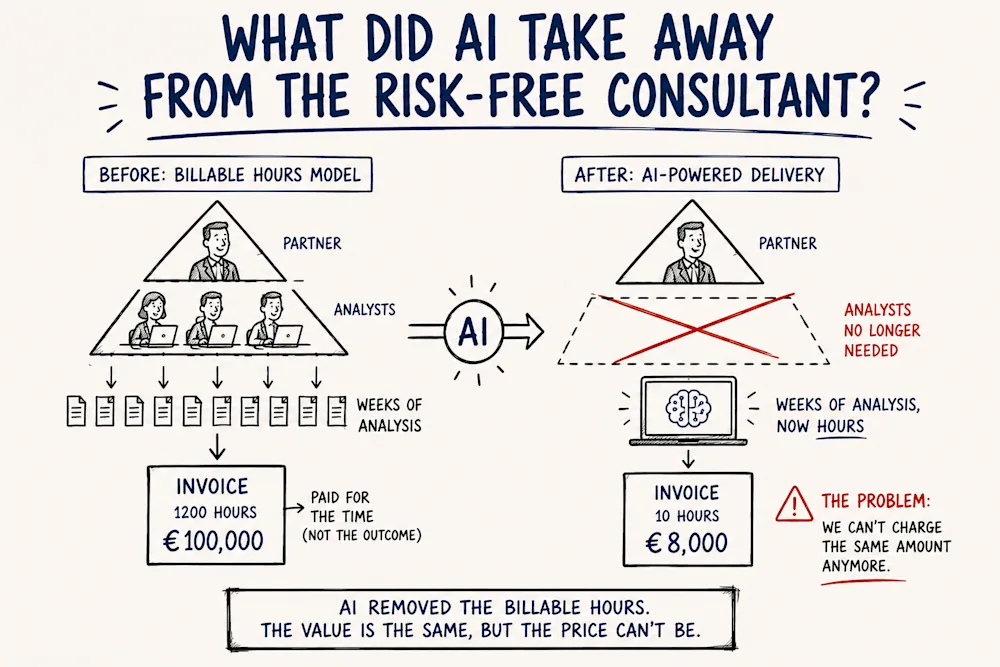
Two practical consequences for you. First, if a proposal prices weeks of data-gathering by the hour, ask what the software does and what the human does. You should be paying for judgement and a result, not for hours a machine has already eaten. Second, expect more consultants to be willing to share risk than a few years ago. Delivering got cheaper, so betting on the result became affordable, and the ones who believe in their own work will take the bet. Ask for it.
Before you sign
Read the fee line of your next proposal against this list.
Buying a conversation? Hourly is fine. That is what it is for.
Buying a defined piece of work, a diagnostic, a plan, a system? Fixed price, named deliverables, end date. Nothing less.
Buying execution? Ask the belief question, and listen carefully to the answer.
Offered equity terms? Someone believes in your company. Take that seriously, whatever you decide, and remember what it costs if they are right.
Whichever model you choose, you now know what it makes your consultant want, and how much of the risk stays with you. That, far more than the rate, is what you are really negotiating.
If you want to see what a fixed-price, fixed-end piece of consulting looks like in practice, start with the diagnostic: a set number of days, a documented method, and a verdict at the end, priced before it begins.