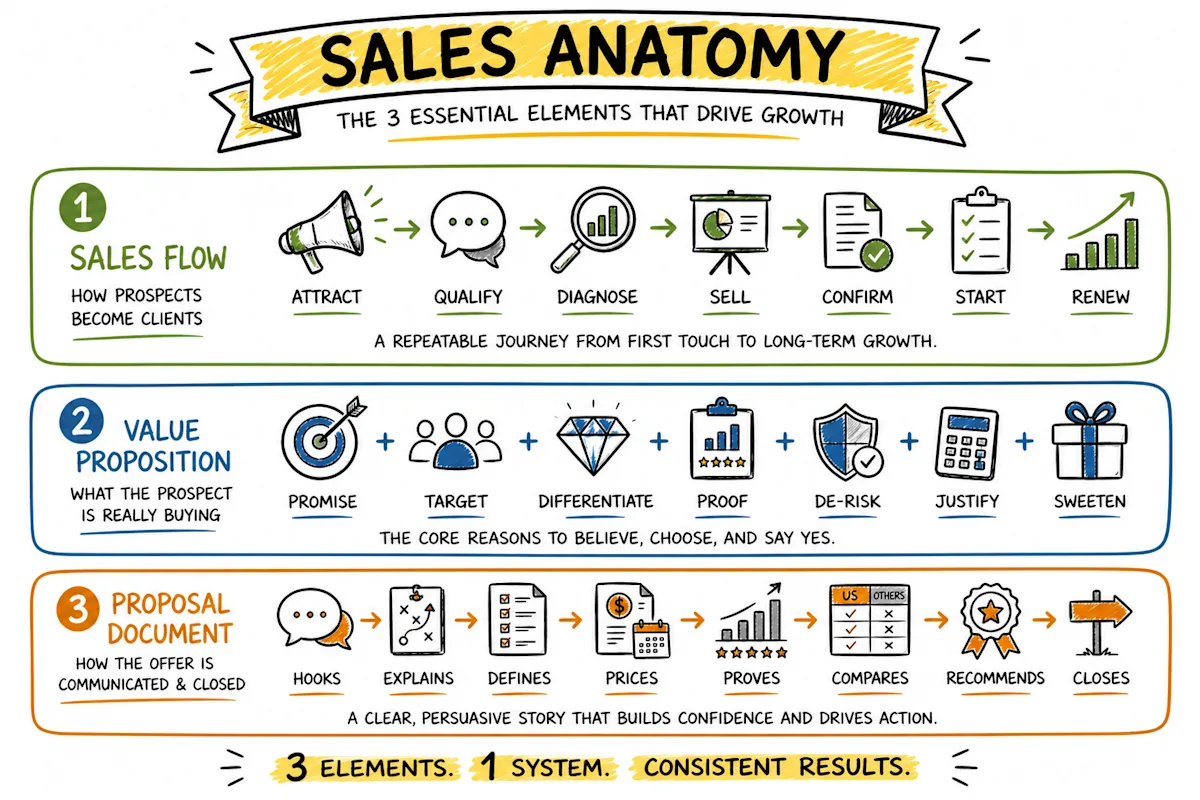
What Your Prospects Are Really Buying: The Anatomy of a Sales Offer
A diagnostic shows where growth is leaking. Turning that into real growth takes a sales offer built for your market, not a generic "improve your sales" template. So I built a framework for it, the Anatomy of a Sales Offer, and I tailor it to each client. Here's the framework, and how the same three layers produced two completely different offers for two companies in opposite markets.
A good business diagnostic tells you where you're losing growth. But knowing the problem isn't the same as fixing it. When the answer is "your sales need to grow," what comes next is usually generic: post more, follow up faster, hire a closer. None of it sticks, because none of it is built around the one thing that decides whether a prospect buys - your specific offer, in your specific market.
So I built a framework for exactly that, and I bring it to every growth engagement. I call it the Anatomy of a Sales Offer. The framework is the same every time. What changes - and what does the real work - is how it's tailored to each client.
The framework: three layers
A complete sales offer has three layers. Get all three right and selling becomes a system instead of a scramble; get one wrong and the other two leak. A sharp value proposition still stalls if the sales flow drops prospects between stages. A clean flow still loses deals if the proposal can't carry the value. The three work together, in order.
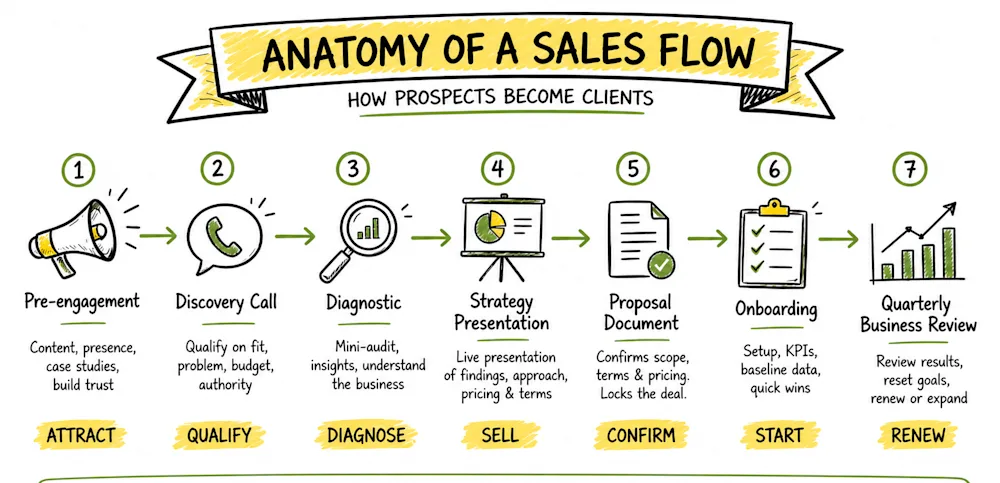
1. Sales Flow - how prospects become clients. The repeatable journey from first touch to renewal: Pre-engagement, Discovery Call, Diagnostic, Strategy Presentation, Proposal, Onboarding, Quarterly Review. Attract, qualify, diagnose, sell, confirm, start, renew. When the flow is defined, no prospect falls through a gap, every stage has a single job, and you can see exactly where deals stall.
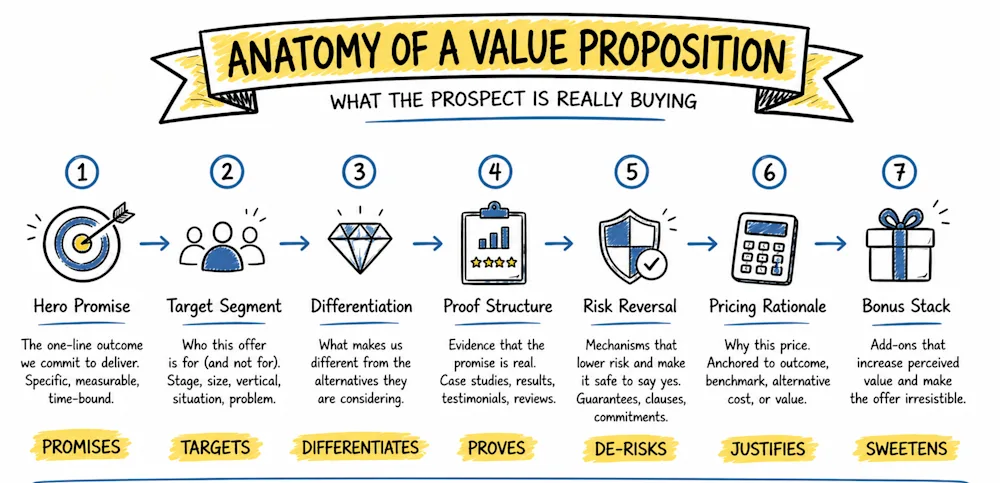
2. Value Proposition - what the prospect is really buying. This is the layer that does the heavy lifting, and the one most offers get wrong. It has seven components: Hero Promise (the one outcome you commit to), Target Segment (who it's for, and who it isn't), Differentiation (why you over the alternatives), Proof (evidence the promise is real), Risk Reversal (how you lower the buyer's risk), Pricing Rationale (why this price), and Bonus Stack (what makes it irresistible).
Each one answers a question running through the prospect's head. The Hero Promise answers "what will this actually do for me?" Differentiation answers "why you and not the three others I'm also talking to?" Risk Reversal answers "what if it doesn't work?" Get all seven aligned and the prospect believes, chooses, and acts. Leave gaps and they fall back on the one comparison every weak offer loses on: price.
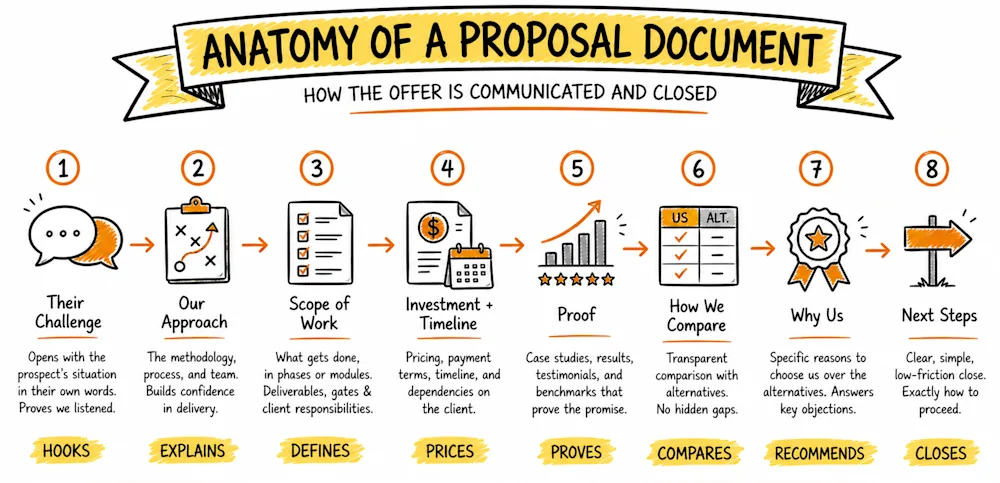
3. Proposal Document - how the offer is communicated and closed. The artefact that carries the value into the sale, written in the order a reader actually decides: Hooks, Explains, Defines, Prices, Proves, Compares, Recommends, Closes. Most proposals lead with the company and the price; a good one leads with the prospect's own situation and earns the price by the time the number appears.
The framework is fixed. The tailoring is the work.
Here's the part that matters. The three layers never change - but a framework you fill in with generic answers is just a template, and templates don't sell. So for every client I tailor each layer to their market: I study their real competitors and the best practice in their industry, map where everyone clusters, and build the offer to win in that specific arena.
The clearest way to show it is two real engagements - both grew out of a successful diagnostic - where the very same framework produced two completely opposite offers, because the two markets were opposite.
Case A: a B2B agency in a crowded market. This company competed in a field full of near-identical players, all promising roughly the same thing. The hard problem was differentiation: how do you get chosen when you look like everyone else? So the tailoring went deep on the competition. I studied how the leading players in their niche expressed every one of the seven value-proposition components - their promises, their proof, their pricing logic, their guarantees - and mapped exactly where the whole market clustered. The open space was what no one had claimed. The output was a sharp, ownable position, plus a clear path from a mid-market offer to a premium one as they grew.
Case B: a Platform-as-a-Service company in a sparse market. This company had the opposite problem: only a handful of players locally, measured by buyers against a few global category giants. The challenge wasn't standing out in a crowd, it was justifying a premium price with so few local reference points. So the tailoring went the other way. I benchmarked the global category standard and the one direct local rival, and anchored the value proposition on depth and methodology - concrete, hard-to-copy reasons to pay more, rather than reasons to merely be noticed.
Same framework, two opposite offers. Put the two side by side, component by component, and the point is undeniable:
- Hero Promise - Case A: a specific, outcome-anchored promise that stands apart from vague competitor claims. Case B: a promise anchored to the scale and certainty of the result, to justify a premium.
- Differentiation - Case A: carve a unique position in a sea of lookalikes. Case B: prove a depth the few rivals can't match.
- Proof - Case A: stack case studies and results to break out of the pack. Case B: lean on methodology, data depth, and the standard the global players set.
- Pricing Rationale - Case A: a tiered path that signals room to grow. Case B: a premium anchored to the value the global giants made the benchmark.
One framework. Two markets. Two offers that share a skeleton and nothing else. That's the difference between a template and tailored work - and the same logic ran through the other two layers too, with each company's sales flow and proposal document shaped around how their buyers actually decide.
Built with the team, not handed over
None of this was a document dropped on a desk. Each layer was built in a facilitated workshop with the company's own people - the founders, the sales lead, the ones who actually talk to buyers. They bring the market knowledge; the framework gives it structure; together we make the calls, component by component. The result reflects their reality and, just as important, they own it and can keep using it long after I leave.
Want this applied to your sales?
If your diagnostic pointed at sales and growth, this is the work that follows: the Anatomy of a Sales Offer, tailored to your market, your competitors, and your buyers. It's exactly what we do in a Business Pulse growth engagement, and it starts from the clarity a diagnostic gives.
If you'd like us to apply this same framework to your sales offer, let's talk. That's the whole point of building it.